Showing posts with label Blackhole. Show all posts

Monday, November 10, 2008

Astronomy update


What's happening at the center of active galaxy 3C 75? The two bright sources at the center of this composite x-ray (blue)/ radio (pink) image are co-orbiting supermassive black holes powering the giant radio source 3C 75. Surrounded by multimillion degree x-ray emitting gas, and blasting out jets of relativistic particles the supermassive black holes are separated by 25,000 light-years. At the cores of two merging galaxies in the Abell 400 galaxy cluster they are some 300 million light-years away. Astronomers conclude that these two supermassive black holes are bound together by gravity in a binary system in part because the jets' consistent swept back appearance is most likely due to their common motion as they speed through the hot cluster gas at 1200 kilometers per second. Such spectacular cosmic mergers are thought to be common in crowded galaxy cluster environments in the distant universe. In their final stages the mergers are expected to be intense sources of gravitational waves.

Located just 500 light-years away toward the constellation Scorpius, this star is only slightly less massive and a little cooler than the Sun. But it is much younger, a few million years old compared to the middle-aged Sun's 5 billion years. This sharp infrared image shows the young star has a likely companion positioned above and left - a hot planet with about 8 times the mass of Jupiter, orbiting a whopping 330 times the Earth-Sun distance from its parent star. The young planetary companion is still hot and relatively bright in infrared light due to the heat generated during its formation by gravitational contraction. In fact, such newborn planets are easier to detect before they age and cool, becoming much fainter. Though over 300 extrasolar planets have been found using other techniques, this picture likely represents the first direct image of a planet belonging to a star similar to the Sun.

Why would Saturn show such strange colors? The robotic Cassini spacecraft currently orbiting Saturn has beamed back images showing that the northern hemisphere our Solar System's most spectacularly ringed planet has changed noticeably since Cassini arrived in 2004, now sporting unusual and unexpected colors. No one is sure why. Although the cause for many of Saturn's colors is unknown, the recent change in colors is thought to be related to the changing seasons. Pictured above, the unusual colors are visible just north of the dark ring shadows. The razor-thin plane of ring particles is visible nearly edge-on across the bottom of the image. The cloudy moon Titan looms large just above the rings, while close observation will reveal three other moons. Cassini arrived at Saturn in 2004, sending back data and images that have not only led to a deeper understanding of the Jovian world's atmosphere, moons, and rings, but also raised new mysteries.

On September 30, a spectacular bolide or fireball meteor surprised a group of amateur astronomers enjoying dark night skies over the Oklahoma panhandle's Black Mesa State Park in the Midwestern US. Flashing past familiar constellations Taurus (top) and Orion, the extremely bright meteor was captured by a hillside camera overlooking the 2008 Okie-Tex Star Party. Astronomy enthusiast Howard Edin reports that he was looking in the opposite direction at the time, but saw the whole observing field light up and at first thought someone had turned on their car headlights. So far the sighting of a such a bright bolide meteor, produced as a space rock is vaporized hurtling through Earth's atmosphere, really is a matter of luck.

Nineteenth century science fiction author Jules Verne wrote visionary works about Extraordinary Voyages including tales of space flight and the story of a journey From the Earth to the Moon. Fittingly, the European Space Agency's newly developed Automated Transfer Vehicle (ATV), a robotic spacecraft intended to deliver cargo to the International Space Station (ISS) was named in his honor and successfully docked with the ISS earlier this year. When the Jules Verne ATV was undocked and deorbited last month, its safely controlled reentry over the Pacific Ocean was followed by astronomers in order to make detailed comparisons of the actual event with computer models of spacecraft reentry and breakup in the atmosphere. This dramatic image of the fragmenting, 13-ton spacecraft is a high definition video frame recorded from NASA's DC-8 Airborne Laboratory.

Imagine a pipe as wide as a state and as long as half the Earth. Now imagine that this pipe is filled with hot gas moving 50,000 kilometers per hour. Further imagine that this pipe is not made of metal but a transparent magnetic field. You are envisioning just one of thousands of young spicules on the active Sun. Pictured above is perhaps the highest resolution image yet of these enigmatic solar flux tubes. Spicules dot the above frame of solar active region 10380 that crossed the Sun in 2004 June, but are particularly evident as a carpet of dark tubes on the right. Time-sequenced images have recently shown that spicules last about five minutes, starting out as tall tubes of rapidly rising gas but eventually fading as the gas peaks and falls back down to the Sun. These images also indicate that the ultimate cause of spicules is sound-like waves that flow over the Sun's surface but leak into the Sun's atmosphere.

Tuesday, March 04, 2008

How to destroy the Earth, part 7


7. Sucked into a giant black hole

You will need: a black hole, extremely powerful rocket engines, and, optionally, a large rocky planetary body. The nearest black hole to our planet is 1600 light years from Earth in the direction of Sagittarius, orbiting V4641.

Method: after locating your black hole, you need get it and the Earth together. This is likely to be the most time-consuming part of this plan. There are two methods, moving Earth or moving the black hole, though for best results you'd most likely move both at once. See the Guide to moving Earth for details on how to move the Earth. Several of the methods listed can be applied to the black hole too, though obviously not all of them, since it is impossible to physically touch the black hole, let along build rockets on it.

Earth's final resting place: part of the mass of the black hole.

Feasibility rating: 6/10. Very difficult, but definitely possible.

Sources: The Hitch Hiker's Guide To The Galaxy, by Douglas Adams; space.com.


Comments: It's clear that dropping the Earth into a singularity is massive overkill. A reasonably strong gravitational field, such as might be associated with any body between Jupiter and a neutron star, would be sufficient to rip the Earth apart via tidal forces. These possibilities are dealt with further down.

Friday, January 18, 2008

How to destroy the Earth, part 3


3.
Sucked into a microscopic black hole

You will need: a microscopic black hole.

Note that black holes are not eternal, they evaporate due to Hawking radiation. For your average black hole this takes an unimaginable amount of time, but for really small ones it could happen almost instantaneously, as evaporation time is dependent on mass. Therefore your microscopic black hole must have greater than a certain threshold mass, roughly equal to the mass of Mount Everest.

Creating a microscopic black hole is tricky, since one needs a reasonable amount of neutronium, but may possibly be achievable by jamming large numbers of atomic nuclei together until they stick. This is left as an exercise to the reader.

Method: simply place your black hole on the surface of the Earth and wait. Black holes are of such high density that they pass through ordinary matter like a stone through the air. The black hole will plummet through the ground, eating its way to the centre of the Earth and all the way through to the other side: then, it'll oscillate back, over and over like a matter-absorbing pendulum. Eventually it will come to rest at the core, having absorbed enough matter to slow it down. Then you just need to wait, while it sits and consumes matter until the whole Earth is gone.

Earth's final resting place: a singularity with a radius of about nine millimetres, which will then proceed to happily orbit the Sun as normal.

Feasibility rating: 3/10. Highly, highly unlikely. But not impossible.

Comments: Getting closer!

Source: The Dark Side Of The Sun, by Terry Pratchett. It is true that the microscopic black hole idea is an age-old science fiction mainstay which predates Pratchett by a long time, he was my original source for the idea, so that's what I'm putting.


I also found this article on the same subject!!!!

No, really -- you just don't want to know this. There’s a remote, but extremely terrifying possibility our planet is about to be swallowed from within by a man-made black hole. In fact, our planet could be booby trapped with baby black holes already.

It is one weird way to go. One moment, you’re here. And the next -- you’re not. It will be sudden, and dramatic. Within seconds, the planet, with everything and everyone on it, is reduced to nothingness. Or actually: it is squeezed together into a tiny black hole, no more than 9 millimeters wide.

If you were to play back the tape of what went wrong very slowly, you would see something very peculiar. Suddenly, you would see the Earth deform. Obviously, not a very good sign. Our planet is flattened out to become a disk. Beams of radiation shoot up from where the poles used to be. And then, zzzp, the planet’s gone. Just like that. Within a split second, it would simply vanish, right before your eyes.

Understandably, on board the International Space Station, this will cause some confusion, to say the very least. Astronauts will be stunned to find that their space ship suddenly no longer orbits a planet -- but, well, nothing much really. The only thing that is out there, is a tiny black spot, invisible to the eye. Still, the speck has the same mass as the Earth. For the time being, the Space Station will remain in orbit, just like the Moon and the satellites. A very silly thing to see, of course.

Perhaps some astronauts will realize what has happened. They might recall how back in the early 21st century, physicists tried to create baby black holes in the lab. And now, many years later... Well, the black holes obviously did show up, after all.

Let's build a hole: The science of DIY black holes

Luckily, the chances of the disaster outlined above really happening should be vanishingly small. But: some risk is there all the same.
There goes the Earth...

First, you should know that in principle, making a black hole is easy. Basically, the only thing you need to do is to slam two tiny, subatomic particles together in a particle accelerator. If you use enough force, the collision should yield a tiny black hole. (To find out what a black hole is, read our section on black holes from space).

Until recently, most scientists believed creating baby black holes couldn’t be done on our planet. You would need a particle accelerator as big as the solar system, most scientists assumed. But nowadays, that's all changed. Quite a lot of physicists think a much smaller particle accelerator can do the trick, too. Such as the ‘Large Hadron Collider’ (LHC), a particle smasher to be opened in Switserland in 2007.

Luckily, a man-made black hole won’t be a roaring monster that gobbles up planets and stars. Rather, science expects an incredibly tiny baby black hole, much smaller than an atom. What's more, it should evaporate immediately. Black holes give off radiation. And our black hole would be so incredibly small and hot, it would radiate itself away in less than 0,00000000000000000000000001 seconds! That’s why physicists feel pretty confident about working with the LHC. No problem if a black hole shows up. According to the laws of physics, black holes from the lab just shouldn’t be stable.

BUT. There is always a small possibility that the predictions are wrong. Particle accelerators are there to break new ground -- to explore new physics. And the physics science is about to explore, is really new and exotic. Nobody has ever seen a mini black hole. In fact, no one has even the faintest idea how gravity works on very small objects.


So, it’s 2007, and science switches on its LHC. According to some calculations, this super particle accelerator could summon up one black hole every second! There they are: black hole, black hole, black hole; Pop! Pop! Pop! Now suppose that against all expectations, these baby black holes aren’t the fleeting, unstable mini monsters we expect them to be. Suppose they’re stable.

At first, no one would notice. They wouldn’t eat up the lab or something. Instead, they would escape. One by one, the baby black holes would leak away from the lab, going through concrete walls as if they didn’t exist. If you’re that small, traveling through solid objects is no problem: you just rarely bump into a molecule.

And then? Slowly, our refugee black holes would begin to sink towards the center of the Earth, attracted by gravity. And there, they would sit and wait.

But sooner or later, a hole will indeed bump into an obstacle. An electron, or an atom’s nucleus -- tiny stuff like that. The black hole will swallow whatever it encounters. This will make it heavier. It will have more gravity, and pull in some more particles. It will get heavier still. And suck in more and more matter.

Eventually, the black holes will merge. They will suck up the Earth’s core, the mantle, and finally -- the entire planet.

Gladly, it could take a baby black hole thousands, if not hundreds of thousands of years to mature. That should give us some time to learn more about them. But the bad news is that even in the distant future, there isn’t much we can do. You cannot find or catch a black hole that is so small you cannot even see it, and that hides deep within the molten iron core of the planet. The only option is to evacuate the planet, if we happen to discover the predictions were wrong.

So, should we leave?

Well, that’s hard to say. As far as we know, everything should be okay. Our world is constantly being bombarded by tiny, high energy particles from outer space. This should also create mini black holes, high up in the atmosphere: up to one hundred each year. And as far as we know, these black holes are indeed unstable. For the last 4,5 billion of years, our planet didn’t die.

On the other hand: in physics, quite often, a totally unexpected, new phenomenon pops up. In recent years, physicists lifted their eyebrows over dark energy, the Pioneer anomaly, the missing of the Higgs boson, the pentaquark and the suspected drift of the fundamental constants. No, we're not going to explain all that -- but the bottom line is this: physicists are constantly being surprised by weird new stuff that wasn't in the theories yet.

Now, you don't want to be such a surprise to be a black hole that has our planet for breakfast!

And then there’s this. In march 2005, scientists working on the Relativistic Heavy Ion Collider in Upton, New York created a fireball that indeed looked awfully much much like a black hole.

It was unstable. In fact, it wasn't even a real black hole. Or so the scientists involved say. Perhaps the first man-made black hole is on its way to the center of the planet already!

Wednesday, September 05, 2007

Hypernovae


So what could be more fun than a supernova? You know, them REALLY big explosions that you get when massive stars die. They make nebualas and send shock waves rippling into space across 1000's of light years. They end up making blackholes or neutron stars.

Well there are explosions out there upto the size of 1000 supernova! Thats right, explosions equal to 1000 supernova all in one go! They've been named Hypernovae, formobvious reasons. A guess of what causes them is two blackholes, or a neurton star and a black hole colliding.


The have been detected by whats known as Gamma Ray Bursts (GRB). These can only be detetced from space, so where first discovered on in the 50's when spy satalites started being put on orbit. The explosion collapeses into as spinning ball, and jets of pure energy, in the form of gamma radiation are fired out from poles at each end. The power of these jets is plane staggering and is hard to comprehend.


When they were first discovered, it wasnt know that they were very narrow-beam jets; the scientists asumed it was the whole explosion they were witnessing. So they did the maths and calculated that the explosion was bigger than the Big Bang - which wasnt possible. That would have blown the whole Universe up! So the energy coming from either pole in a beam across space is measured in the same terms as the explosion that created of the universe. Nows thats big! :) It was 13 Billion lightyears away, and still was the largest release of energy man has ever witnessed.


If one of these beams ever hit Earth it would fry the atmosphere in seconds, and that would be that! But as the GRB's are only ever in a very narrow beam we would have to be, very, very unlucky for Earth to be lying in the direct path of one of the beams - but its possible. Oh, and we witness about 50 every year. Now wheres my odds calculator?

Have a nice day! :)

Sunday, August 27, 2006

Black Holes & Mira, the Wonderful Star

Ever since I heard what a Black Holes is I wanted to see one! Ever see that cheesy Disney movie from the 70's Blackhole? It fascinated me.


Since the creation of the Hubble Telescope it was only a matter of time before we got to see one. Buts whats that I hear you say? You cant see a blackhole because light cant esacpe from it? Well that is true; you might not be able to see the blackhole, but you can certainly see its passing!!

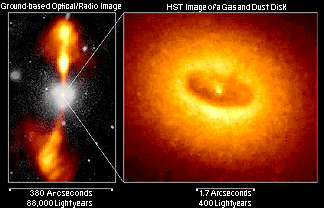
When a Blackhole passes close to a star, it starts to suck it in. The matter from the star streams towards the BH. As BH's are rotating the matter from the star starts to swirl around the event horizon of the BH just like a whirlpool. The gravity is so strong that the matter rotates close to the speed of light. They call this an accretion disc. You certainly can see those.

In fact the gravity is so strong that the BH sucks in far more matter than it can swallow. It ends up throwing out billions of tons of stellar matter from either pole. It throws them thousands of light years into space in two continuous jets.

Its not just BH's that create accretion disks. White Dwarf and Neutron stars do also. Both are the remains of collapsed stars that werent quite big enough to make a BH. The gravity they immit is still huge. A neutron star can have a diameter of 25k kilometres but have the gravity of a million Suns!!!

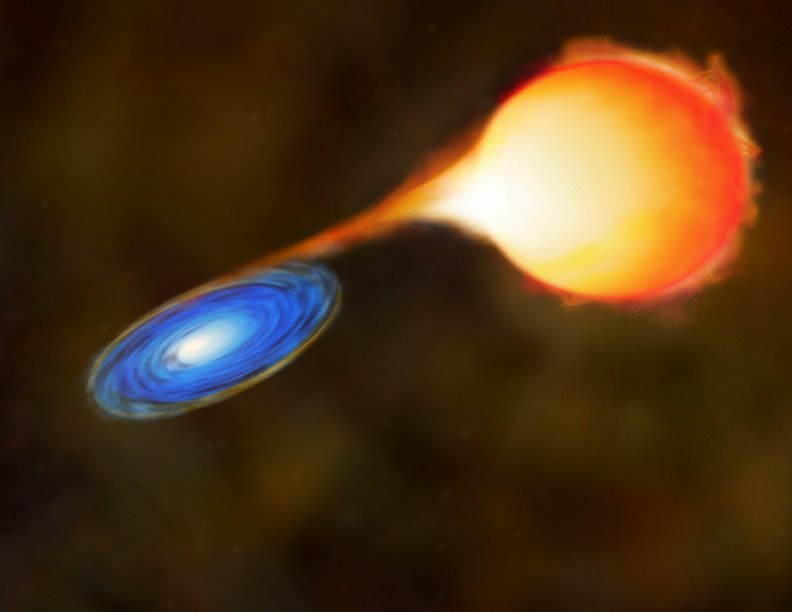
The last pictures are of Mira, the Wonderful Star, so called for its unusual fluctuations of brightness. Scientists now know Mira is a binary star system, with Mira A, a nice normal bright star, and Mira B, a White Dwarf star that is pulling huge amounts of solar matter from Mira A towards itself. The matter is spinning around Mira B at a huge speed kicking out emense amounts of radiaition. Radiaion is the main give-away for a BH.

The final picture is an artists recreation of what the Mira system might look like.


Nice.