
I know I've covered this subject with a series of pics a while ago, but someone has put an animation together showing the relative sizes of planets and stars.
A-Mazing! How bloody big? lol
Showing posts with label Universe. Show all posts
Showing posts with label Universe. Show all posts
Thursday, July 01, 2010


Saturday, February 06, 2010
The Known Universe
A fantastic short film showing just how small our little planet is in the grand scheme of things!
Monday, September 29, 2008


Monday, April 28, 2008
Harewood House planetarium


Harewood House stately home near Harrogate has a planetarium in it now. I went with my dad and my brother last week.
It is a temporary structure, but is still a very impressive one. I have only ever been to one other planetarium before, and that was in Montreal.

This one has one seriously impressive projector in it. Some monster that spins in 360 degress and has over 100,000 fibre optic lights in it. Each one perfectly correlates to a visible star. So each star that they project is the perfect brightness and colour as we would see if we looked in the night sky.

But this mad beastie can do crazy things like show you what the sky would look like 14,000 years from now; so all the stars start shooting around the sky showing the passage of time. Other crazy tricks like zooming in on Jupiter and watching its moons orbit around it perfectly. It was dead impressive! It can do both hemispheres, so the Southern Cross and other astronomical sights only visible down under can be seen. Me Wants One Now!

Plus outside they have a 60 foot climbing frame and slide. So me and my brother, aged 34 and 39 climbed up to the top and slid down lol. Still the biggest kids there!
A great evening out!
Saturday, April 19, 2008
The Cats Eye Nebula

"Staring across interstellar space, the alluring Cat's Eye Nebula lies three thousand light-years from Earth. One of the most famous planetary nebulae in the sky, the Cat's Eye (NGC 6543) is over half a light-year across and represents a final, brief yet glorious phase in the life of a sun-like star. This nebula's dying central star may have produced the simple, outer pattern of dusty concentric shells by shrugging off outer layers in a series of regular convulsions. But the formation of the beautiful, more complex inner structures is not well understood. Here, Hubble Space Telescope archival image data has been reprocessed to create another look the cosmic cat's eye. Compared to well-known Hubble pictures, the alternative processing strives to sharpen and improve the visiblility of details in light and dark areas of the nebula and also applies a more complex color palette. Of course, gazing into the Cat's Eye, astronomers may well be seeing the fate of our Sun, destined to enter its own planetary nebula phase of evolution ... in about 5 billion years."

Friday, April 18, 2008
Monthly moon round-up - Phobos

"This moon is doomed. Mars, the red planet named for the Roman god of war, has two tiny moons, Phobos and Deimos, whose names are derived from the Greek for Fear and Panic. These martian moons may well be captured asteroids originating in the main asteroid belt between Mars and Jupiter or perhaps from even more distant reaches of the Solar System. The larger moon, Phobos, is indeed seen to be a cratered, asteroid-like object in this stunning color image from the Mars Reconnaissance Orbiter, recorded at a resolution of about seven meters per pixel. But Phobos orbits so close to Mars - about 5,800 kilometers above the surface compared to 400,000 kilometers for our Moon - that gravitational tidal forces are dragging it down. In 100 million years or so Phobos will likely be shattered by stress caused by the relentless tidal forces, the debris forming a decaying ring around Mars."

"Stickney Crater, the largest crater on the martian moon Phobos, is named for Chloe Angeline Stickney Hall, mathematician and wife of astronomer Asaph Hall. Asaph Hall discovered both the Red Planet's moons in 1877. Over 9 kilometers across, Stickney is nearly half the diameter of Phobos itself, so large that the impact that blasted out the crater likely came close to shattering the tiny moon. This stunning, enhanced-color image of Stickney and surroundings was recorded by the HiRISE camera onboard the Mars Reconnaissance Orbiter as it passed within some six thousand kilometers of Phobos last month. Even though the surface gravity of asteroid-like Phobos is less than 1/1000th Earth's gravity, streaks suggest loose material has slid down inside the crater walls over time. Light bluish regions near the crater's rim could indicate a relatively freshly exposed surface. The origin of the curious grooves along the surface is mysterious but may be related to the crater-forming impact."
Tuesday, April 08, 2008
The Horsehead Nebula

It occurs to me, that on this photoblog of spacey things, I havent posted many of the most famous sights in astronomy before. Perhaps because they are so "famous" that I assume that everyone will have seen them many times, like me. But, of course, everyone's not a giant nerd like me and may not have seen these things before. So I shall be posting some of the most famous astronomical sights there are. All for you, dear reader; so you can become as nerdy as me! :)
"One of the most identifiable nebulae in the sky, the Horsehead Nebula in Orion, is part of a large, dark, molecular cloud. Also known as Barnard 33, the unusual shape was first discovered on a photographic plate in the late 1800s. The red glow originates from hydrogen gas predominantly behind the nebula, ionized by the nearby bright star Sigma Orionis. The darkness of the Horsehead is caused mostly by thick dust, although the lower part of the Horsehead's neck casts a shadow to the left. Streams of gas leaving the nebula are funneled by a strong magnetic field. Bright spots in the Horsehead Nebula's base are young stars just in the process of forming. Light takes about 1500 years to reach us from the Horsehead Nebula."

"The famous Horsehead Nebula in Orion is not alone. A deep exposure shows that the dark familiar shaped indentation, visible just below center, is part of a vast complex of absorbing dust and glowing gas. To bring out details of the Horsehead's pasture, amateur astronomers at the Star Shadow Remote Observatory in New Mexico, USA fixed a small telescope on the region for over seven hours filtering out all but a very specific color of red light emitted by hydrogen. They then added the image to a full color frame taken over three hours. The resulting spectacular picture details an intricate tapestry of gaseous wisps and dust-laden filaments that were created and sculpted over eons by stellar winds and ancient supernovas. The Horsehead Nebula lies 1,500 light years distant towards the constellation of Orion. Two stars from the Orion's Belt can be found in the above image."
Saturday, March 29, 2008
Uranus

Its one of the big gas giants, but we never hear much about it, apart from the favourite schoolboy joke about it. A joke even JK Rowling used, to perfection I might add, in one of the Harry Potter book. Notice I've refrained from making any jokes myself about Uranus. I shall leave it up to my readerships foul and twisted minds to do that for me.

But we have some stunning photos now about the Uranian system. Voyager and Hubble have both capture some beauties, both in real light and a mix of infrared and spectrograph.

So here's some photos of the Uranian system. Enjoy.

PS. I love the fact that the moons are named from A Midsummers Nights Dream, and other Shakespeare characters.

Saturday, February 23, 2008

Friday, February 08, 2008
Light Echoes

"What caused this outburst of V838 Mon? For reasons unknown, star V838 Mon's outer surface suddenly greatly expanded with the result that it became the brightest star in the entire Milky Way Galaxy in January 2002. Then, just as suddenly, it faded. A stellar flash like this has never been seen before -- supernovas and novas expel matter out into space. Although the V838 Mon flash appears to expel material into space, what is seen in the above image from the Hubble Space Telescope is actually an outwardly moving light echo of the bright flash. In a light echo, light from the flash is reflected by successively more distant rings in the complex array of ambient interstellar dust that already surrounded the star. V838 Mon lies about 20,000 light years away toward the constellation of the unicorn (Monoceros), while the light echo above spans about six light years in diameter."
Monday, October 15, 2007
Its a beautiful universe

I've been away for a few days to Blackpool (dont ask! lol), and it seems a vertiable dearth of beautiful images.

So heres something to feast your eyes on at the start of the working week. Click on them to enlarge. :)

Its all rather pretty out there :D

1. The complexity of Jupiters clouds
2. Ice geysers on Saturns moon Enceladus. The geysers are estimated to be 0 degrees Celcius, but as the planet itself is -200C then it will geyser like crazy.
3. The Whale and the Hockystick galaxies.
4. And the most beautiful photo of an aurora I've ever seen.
Monday, October 08, 2007
Where do we live?

What are these?
Well, these are maps of your homes - and mine. These maps of the Visable Universe.

This is what we can see in an arc of 360 degrees, going riiiiiight out to the edge of what we can see, which is 13 Billion lightyears away! :)
So what is our address? Well, mine is:
Hampswthaite Road
Harrogate
North Yorkshire
United Kingdom
Planet Earth
The Milky Way Galaxy
The Virgo Supercluster
HG1 2DU
Please check out this fantastic site: http://www.atlasoftheuniverse.com/
This is an interative map of the universe, starting with us, and moving outwards until the edge of the visable universe. Its well cool!

Now was it left, or right at Sagittarius?
Wednesday, September 05, 2007
Hypernovae


So what could be more fun than a supernova? You know, them REALLY big explosions that you get when massive stars die. They make nebualas and send shock waves rippling into space across 1000's of light years. They end up making blackholes or neutron stars.
Well there are explosions out there upto the size of 1000 supernova! Thats right, explosions equal to 1000 supernova all in one go! They've been named Hypernovae, formobvious reasons. A guess of what causes them is two blackholes, or a neurton star and a black hole colliding.

The have been detected by whats known as Gamma Ray Bursts (GRB). These can only be detetced from space, so where first discovered on in the 50's when spy satalites started being put on orbit. The explosion collapeses into as spinning ball, and jets of pure energy, in the form of gamma radiation are fired out from poles at each end. The power of these jets is plane staggering and is hard to comprehend.

When they were first discovered, it wasnt know that they were very narrow-beam jets; the scientists asumed it was the whole explosion they were witnessing. So they did the maths and calculated that the explosion was bigger than the Big Bang - which wasnt possible. That would have blown the whole Universe up! So the energy coming from either pole in a beam across space is measured in the same terms as the explosion that created of the universe. Nows thats big! :) It was 13 Billion lightyears away, and still was the largest release of energy man has ever witnessed.

If one of these beams ever hit Earth it would fry the atmosphere in seconds, and that would be that! But as the GRB's are only ever in a very narrow beam we would have to be, very, very unlucky for Earth to be lying in the direct path of one of the beams - but its possible. Oh, and we witness about 50 every year. Now wheres my odds calculator?
Have a nice day! :)
Friday, August 10, 2007
How many suns?


Guess what? One sun per solar system is not the norm. Apparently, its about 50/50 between one sun, and a binary system. Some systems even have more than two suns in them!

Is that strange? Probably not. Virtually all solar systems that have been discovered to have planets, have gas giants in them. We have 4 gas giants in our system; Jupiter, Saturn, Uranus, and Neptune. Jupiter, our biggest planet, is also classified as a Brown Giant, or a Glowing Planet (meaning that the planet kicks out energy from its own internal fusion). It has been estimated that if Jupiter was 5 times the mass, it would probably combust under its own mass and become a star. So Brown Giants are stars that have failed in ignite because they are not fat enough :)

A Gas Giant that is 70% the size of Jupiter has been recently discovered orbiting a sun in the Hercules system. But it is orbiting so close to the star that its atmosphere is being stripped off. In who knows how millions of years, it will have been blown away to nothing!

So its no wonder that there are so many suns out there. We could easily have ended up with a sky that would not look out of place in a Star Wars movie. In fact, the excellent movie 2010 is actually about Jupiter being turned into a sun by mysterious aliens. The movie ends with one of my favourite lines ever "All these worlds are yours, except Europa. Use them together in peace". I would sure enjoy looking at that sky!

So the mind boggles when you realise they have discovered a system with four suns in it! A double binary system. This is an artists impression of it. I wonder what that sky would look like if you could visit a planet in that system and look up?
:)
Wednesday, May 02, 2007
Deep space monster

"Inside the head of this interstellar monster is a star that is slowly destroying it. The monster, actually an inanimate pillar of gas and dust, measures over a light year in length. The star, not itself visible through the opaque dust, is bursting out partly by ejecting energetic beams of particles. Similar epic battles are being waged all over the star-forming Carina Nebula. The stars will win in the end, destroying their pillars of creation over the next 100,000 years, and resulting in a new open cluster of stars. The pink dots are newly formed stars that have already been freed from their birth monster. The above image is only a small part of a highly detailed panoramic mosaic of the Carina Nebula taken by the Hubble Space Telescope and released last week. The technical name for the stellar jets are Herbig-Haro objects. How a star creates Herbig-Haro jets is an ongoing topic of research, but it likely involves an accretion disk swirling around a central star."
Cool, huh?
Saturday, April 21, 2007
The Red Square Nebula

What could cause a nebula to appear square? No one is quite sure. The hot star system known as MWC 922, however, appears to be imbedded in a nebula with just such a shape. The above image combines infrared exposures from the Hale Telescope on Mt. Palomar in California, and the Keck-2 Telescope on Mauna Kea in Hawaii. A leading progenitor hypothesis for the square nebula is that the central star or stars somehow expelled cones of gas during a late developmental stage. For MWC 922, these cones happen to incorporate nearly right angles and be visible from the sides. Supporting evidence for the cone hypothesis includes radial spokes in the image that might run along the cone walls. Researchers speculate that the cones viewed from another angle would appear similar to the gigantic rings of supernova 1987A, possibly indicating that a star in MWC 922 might one day itself explode in a similar supernova.
Sunday, November 12, 2006
The Hubble Deep Field

I have been reminded how cool the Hubble telescope Deep Field is. By pointing the telescope at a seemingly empty patch of sky, and leaving the exposure open, they have captured these amazing shots of how densely populated the universe is. Thousands of galaxys stretching into the visible distance. And each one may contain life!
But Hubble is also a time machine. Everything it can see is from the past. These galaxys are billions of light years away, which means what we are seeing are galaxys that are billions of years old when we see them.
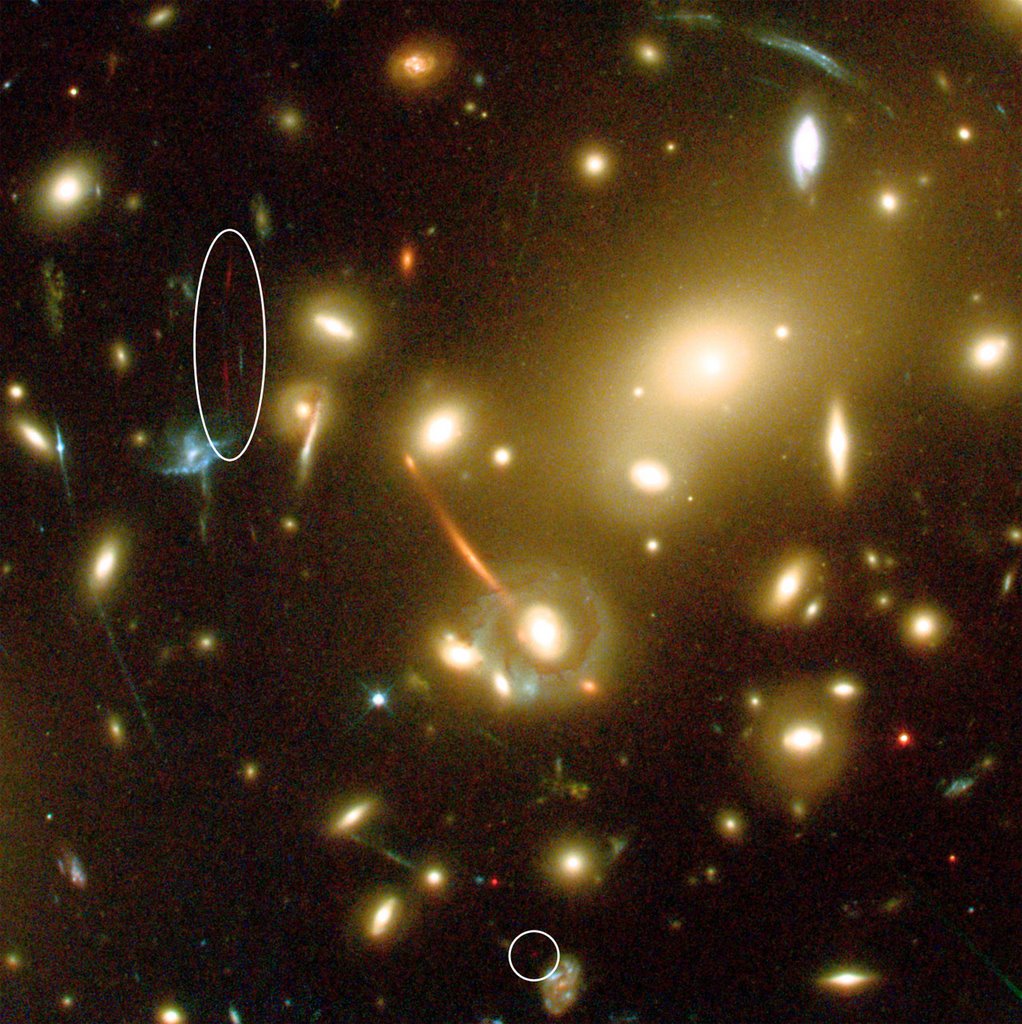
Including this photo of galaxy cluster Abell 2218. Abell is SO fat and its gravity is so strong that it is warping the light from galaxys behind it. It is called gravitational lensing and it makes light from behind it warp around it. You can see multiple images stretched and warped like a lens around it. It also amplifies images, making visable galaxies so far away that they could never be viewed with conventional instruments. The circled area shows a galaxy that is visible only because of the gravitational lensing. When they measured the red shift in the light, they discovered that the galaxy was 13 billion light years away, making the image 13 billion years old. The oldest thing ever seen by far.
Cool, huh?
Wednesday, October 18, 2006

Sunday, August 27, 2006
Black Holes & Mira, the Wonderful Star
 Ever since I heard what a Black Holes is I wanted to see one! Ever see that cheesy Disney movie from the 70's Blackhole? It fascinated me.
Since the creation of the Hubble Telescope it was only a matter of time before we got to see one. Buts whats that I hear you say? You cant see a blackhole because light cant esacpe from it? Well that is true; you might not be able to see the blackhole, but you can certainly see its passing!!
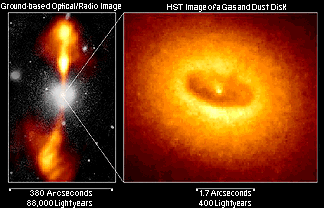 When a Blackhole passes close to a star, it starts to suck it in. The matter from the star streams towards the BH. As BH's are rotating the matter from the star starts to swirl around the event horizon of the BH just like a whirlpool. The gravity is so strong that the matter rotates close to the speed of light. They call this an accretion disc. You certainly can see those.
In fact the gravity is so strong that the BH sucks in far more matter than it can swallow. It ends up throwing out billions of tons of stellar matter from either pole. It throws them thousands of light years into space in two continuous jets.
 Its not just BH's that create accretion disks. White Dwarf and Neutron stars do also. Both are the remains of collapsed stars that werent quite big enough to make a BH. The gravity they immit is still huge. A neutron star can have a diameter of 25k kilometres but have the gravity of a million Suns!!!
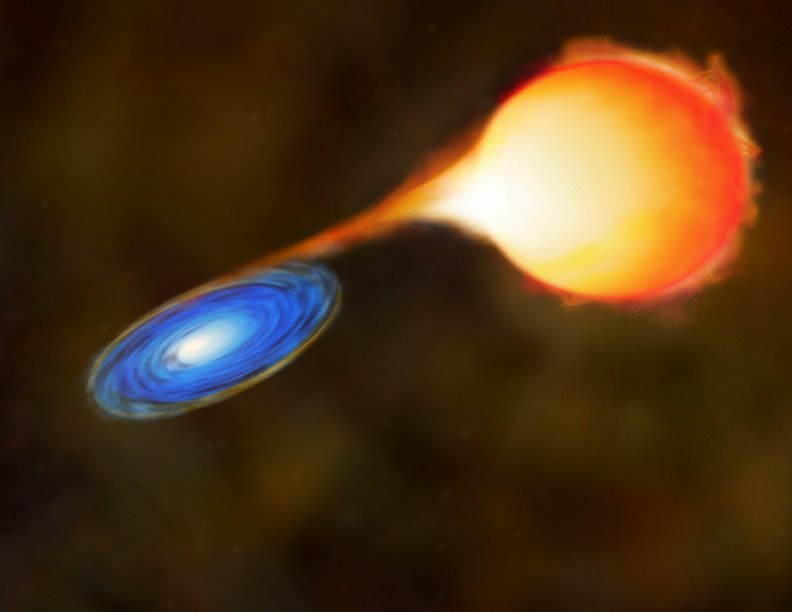 The last pictures are of Mira, the Wonderful Star, so called for its unusual fluctuations of brightness. Scientists now know Mira is a binary star system, with Mira A, a nice normal bright star, and Mira B, a White Dwarf star that is pulling huge amounts of solar matter from Mira A towards itself. The matter is spinning around Mira B at a huge speed kicking out emense amounts of radiaition. Radiaion is the main give-away for a BH.
The final picture is an artists recreation of what the Mira system might look like.
Nice.
Subscribe to:
Posts (Atom)


