Showing posts with label Mars. Show all posts

Friday, November 13, 2009

Tattooed


Who's been marking up Mars? This portion of a recent high-resolution picture from the HiRISE camera on board the Mars Reconnaissance Orbiter shows twisting dark trails criss-crossing light colored terrain on the martian surface. Newly formed trails like these had presented researchers with a tantalizing martian mystery but are now known to be the work of miniature wind vortices known to occur on the red planet - martian dust devils. Such spinning columns of rising air heated by the warm surface are also common in dry and desert areas on planet Earth. Typically lasting only a few minutes, dust devils become visible as they pick up loose red-colored dust leaving the darker and heavier sand beneath intact. On Mars, dust devils can be up to 8 kilometers high. Dust devils have been credited with unexpected cleanings of mars rover solar panels.

Wednesday, August 19, 2009

The sands of Mars


I've not been very good this month with posting stuff, so am going to post a bit more stuff towards the end of the month.

This fantastic photo looks like liquid running, but is in fact a satalite picture of sand dunes on Mars. Nice! :)

Friday, May 15, 2009

Liquid Mars and Rainbow Clouds

A (fairly) nice and straight forward week so far. One of the joys of being in the same location for so long is that I dont have to worry about getting the trucks in and out on a morning and evening, so can just have a more caretaker role, which involves sitting and watching, with occasional shouting bursts lol, like the poor grip who just chucked an apple core outside right in front of me. I pointed him towards the bin ;)

When does Mars act like a liquid? Although liquids freeze and evaporate quickly into the thin atmosphere of Mars, persistent winds may make large sand dunes appear to flow and even drip like a liquid. Visible on the above image right are two flat top mesas in southern Mars, where the season is changing from Spring to Summer. A light dome topped hill is also visible on the far left of the image. As winds blow from right to left, flowing sand on and around the hills leaves picturesque streaks. The dark arc-shaped droplets of fine sand are called barchans, and are the interplanetary cousins of similar Earth-based sand forms. Barchans can move intact downwind and can even appear to pass through each other. Over the past few weeks, winds on southern Mars have been kicking up dust and are being watched to see if they escalate into another of Mars' famous planet-scale sand storms.


Why would clouds appear to be different colors? The reason here is that ice crystals in distant cirrus clouds are acting like little floating prisms. Sometimes known as a fire rainbow for its flame-like appearance, a circumhorizon arc lies parallel to the horizon. For a circumhorizontal arc to be visible, the Sun must be at least 58 degrees high in a sky where cirrus clouds are present. Furthermore, the numerous, flat, hexagonal ice-crystals that compose the cirrus cloud must be aligned horizontally to properly refract sunlight in a collectively similar manner. Therefore, circumhorizontal arcs are quite unusual to see. This circumhorizon display was photographed through a polarized lens above Dublin, Ohio last week.

Wednesday, April 15, 2009

Mud volcano on Mars


Is this a mud volcano on Mars? If so, could it be dredging up martian microbes? This strange possibility has been suggested recently and seems to fit several recent observations of Mars. First of all, hills like this seem to better resemble mud volcanoes on Earth than lava volcanoes and impact craters on Mars. Next, the pictured dome has an unusually textured surface consistent with fractured ice. Infrared images from space indicate that hills like this cool more quickly than surrounding rock, consistent with a dried mud composition. The hills also reflect colors consistent with a composition that formed in the presence of water. Finally, unusual plumes of gas containing methane have been found on Mars with unknown origin. These gas plumes could conceivably have been liberated by mud volcanoes, were the initially warm mud to contain methane-producing microbes drifting in a previously unobservable underground lake. A candidate mud volcano over 100 meters across is pictured above in the northern plains of Mars.

Sunday, January 11, 2009

Sunset on Mars


And the cool thing about Mars? The sky is red at midday and blue at sunrise and sunset. Opposite of Earth :)

Tuesday, December 09, 2008

The Red Planet

Some stunning pics from the planet of the God of War.


Tuesday, September 30, 2008

Its snowing on Mars


This strange picture is proof that it snows on Mars! lol. Cool as!

"Chalk another discovery up to the Mars Phoenix Lander. Several months after finding water ice beneath the Martian soil, the NASA robot has now turned its gaze upward to the sky, and has observed a light snowfall over the polar region. Scientists said the discovery of snow on Mars was made by an instrument that shined a laser into clouds about two miles above the ground, revealing the presence of ice crystals. “Nothing like this has ever been seen on Mars,” said [scientist] Jim Whiteway [Los Angeles Times].

The ice crystals quickly vaporized as they fell through the atmosphere of Mars, but researchers say they’ll be watching during the next two months to see if the snow ever reaches the ground. Over the past few months, as the Martian winter has moved in, Phoenix has also observed frost, ground fog, and clouds of ice crystals.

In another recent experiment, Phoenix examined the composition of the Martian soil and confirmed the presence of calcium carbonates, common clays found in wet environments on Earth…. [T]he presence of carbonates suggests that water was a dominant force in Mars’s early chemistry [National Geographic News]. However, the Phoenix hasn’t yet succeeded in its search for the complex organic molecules that would indicate that the planet was once habitable for microbes.

The Phoenix’s mission is now winding down. Before the end of October, [engineer Barry] Goldstein said, there won’t be enough power left to keep the lander’s robotic arm operating, so digging into the soil and scraping ice samples from beneath the soil will have to stop. By November, Phoenix will be standing rigidly in the pitch dark, and carbon dioxide in the atmosphere will encase it in ice like some otherworldly frozen mummy - at more than 150 degrees below zero Fahrenheit [San Francisco Chronicle]. While the Phoenix has a “Lazarus” program that will send a signal to Earth if its solar panels reactivate after the harsh winter, the lander’s engineers say the chance of a resurrection is extremely slim."

Monday, August 04, 2008

Astronomy Picture of the Day


You might occasionally wonder where I get all the cool photos from space and beyond. NASA have a daily website called (funnily enough) Astronomy Picture of the Day. http://apod.nasa.gov/apod/astropix.html. They have been busy in the last few days. Enjoy! :)


1. The Echus chasm on Mars
2. Jupiter over Hadrians temple in Ephesus
3. Rhea and Saturn
4. The moon over the temple of Posiedon in Greece
5. Soyuz docking with the International Space Station

Tuesday, June 17, 2008

We dig, dig, dig, dig, dig, dig, dig, dig.....


"What's a good recipe for preparing Martian soil? Start by filling your robot's scoop a bit less than half way. Next, dump your Martian soil into one of your TEGA ovens, being sure to watch out for clumping. Then, slowly increase the temperature to over 1000 degrees Celsius over several days. Keep checking to see when your soil becomes vaporized. Finally, your Martian soil is not ready for eating, but rather sniffing The above technique is being used by the Phoenix Lander that arrived on Mars three weeks ago. Data from the first batch of baked soil should be available in a few days. Pictured above, a circular array of the Phoenix Lander's solar panels are visible on the left, while a scoop partly filled with Martian soil is visible on the right. The robotic Phoenix Lander will spend much of the next three months digging, scooping, baking, sniffing, zapping, dissolving, and magnifying bits of Mars to help neighboring Earthlings learn more about the hydrologic and biologic possibilities of the sometimes mysterious red planet."

Wednesday, May 21, 2008

Flying over Mars


Please paste this link into your browser http://apod.nasa.gov/apod/ap080519m.html . This is a digital animation of flying over Mars.

Combining data from orbital scans by the Mars Orbiter, and film taken from the ground level by the Mars Rover; they've combined them into a digital film.

As they say in Speed Racer, "Cool beans!"

Friday, April 18, 2008

Monthly moon round-up - Phobos


"This moon is doomed. Mars, the red planet named for the Roman god of war, has two tiny moons, Phobos and Deimos, whose names are derived from the Greek for Fear and Panic. These martian moons may well be captured asteroids originating in the main asteroid belt between Mars and Jupiter or perhaps from even more distant reaches of the Solar System. The larger moon, Phobos, is indeed seen to be a cratered, asteroid-like object in this stunning color image from the Mars Reconnaissance Orbiter, recorded at a resolution of about seven meters per pixel. But Phobos orbits so close to Mars - about 5,800 kilometers above the surface compared to 400,000 kilometers for our Moon - that gravitational tidal forces are dragging it down. In 100 million years or so Phobos will likely be shattered by stress caused by the relentless tidal forces, the debris forming a decaying ring around Mars."

"Stickney Crater, the largest crater on the martian moon Phobos, is named for Chloe Angeline Stickney Hall, mathematician and wife of astronomer Asaph Hall. Asaph Hall discovered both the Red Planet's moons in 1877. Over 9 kilometers across, Stickney is nearly half the diameter of Phobos itself, so large that the impact that blasted out the crater likely came close to shattering the tiny moon. This stunning, enhanced-color image of Stickney and surroundings was recorded by the HiRISE camera onboard the Mars Reconnaissance Orbiter as it passed within some six thousand kilometers of Phobos last month. Even though the surface gravity of asteroid-like Phobos is less than 1/1000th Earth's gravity, streaks suggest loose material has slid down inside the crater walls over time. Light bluish regions near the crater's rim could indicate a relatively freshly exposed surface. The origin of the curious grooves along the surface is mysterious but may be related to the crater-forming impact."

Tuesday, March 11, 2008

A Martian avalanche!!


What caused this sudden cloud of dust on Mars? An avalanche! The first avalanche imaged in progress on another planet was recorded last month on Mars by NASA's robotic Mars Reconnaissance Orbiter. Visible in the above picture, digitally rescaled, are several layers of white ice thawing over red rock, with darker colors toward the right indicated Martian soil that mixed with lesser amounts of ice. As the cliff of over 700 meters high was thawing, falling ice crashed down raising plumes of ice and dust so thick they cast visible shadows. The scarp has slopes with grades greater than 60 degrees. The entire scene is illuminated from the upper right by the Sun. A thaw occurs each spring in the Northern Hemisphere of Mars, as the warming climate causes solid carbon dioxide ice to sublimate directly to vapor.

Now how cool is that?!?! :)

Thursday, March 06, 2008

Spring is coming


What are these strange shapes on Mars? Defrosting sand dunes. As spring now dawns on the Northern Hemisphere of Mars, dunes of sand near the pole, as pictured above, are beginning to thaw. The carbon dioxide and water ice actually sublime in the thin atmosphere directly to gas. Thinner regions of ice typically defrost first revealing sand whose darkness soaks in sunlight and accelerates the thaw. The process might even involve sandy jets exploding through the thinning ice. By summer, spots will expand to encompass the entire dunes. The Martian North Pole is ringed by many similar fields of barchan sand dunes, whose strange, smooth arcs are shaped by persistent Martian winds.

Monday, October 01, 2007

There are holes in Mars


This fantastic photo is of Mars. On the left hand side you can see 3 dark holes at the top of the ridge. They register no light, so they must be a hole.

So whats creating holes on Mars? No one really knows, but if they are anything like Earth (which we think they are), then these could well be collapsed volcanic tunnels.

One things for sure, they aint half deep!

Monday, August 13, 2007

No place on Earth


I was struck with more than a passing resemblance between these photos.

The first is of ice melting on sand dunes at the Martian pole. The dark spots are sand which doesn't reflect as much light as the water ice from the winter months.

The second* is of the banks of the Dead Sea in Jordon. I remember from my trips to Israel and Jordan that the landscape of the Negev Desert really looked like no place on earth.

It seems it(3) bears more of a resemblance to Mars(4).

:)

* I'm not too proud to nick a nice photo, Alexander! Thank you ;)


Wednesday, July 04, 2007

Canyons and cliffs


I have been posting a lot of Earthbound posts recently. To take a break from Earthly pleasures, I shall post some extra-terrestrial photos too.

I came across this magnificent picture of some cliffs at Mars' north pole. They are 2km high! Fantastic!


But not the biggest in our solar system. On planet Earth it is not the Grand Canyon that is our deepest canyon, but the Colca Canyon in Peru, where the cliffs drop over 4.5km deep.


But even they pale into insignificance when we look at Verona Rupes on Uranus' moon Miranda. We have cliffs a staggering 2okm high!! Boy I would love to see an up-close photo of them!!

Monday, October 16, 2006

Mars from orbit


This is the view of the Victoria Crater on Mars, as taken by the MarsExpress Orbiter.

You can actually see the Mars Beagles tracks from space.

Cool.

Sunday, September 03, 2006

The Grand Canyon


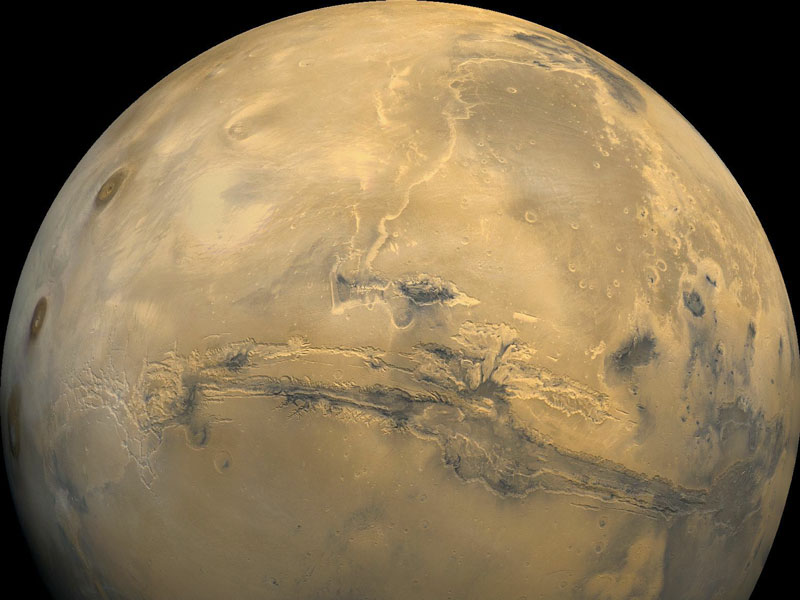
This is Valles Marineris on Mars.

"The Valles Marineris is a system of canyons located just south of the Martian equator. The system is about 4000 km long, and, if on earth, would extend all the way across the United States. The central individual troughs, generally 50 to 100 km wide, merge into a depression as much as 600 km wide. In places the canyon floor reaches a depth of 10 km, 6 to 7 times deeper than the Grand Canyon"

Big, huh?

Friday, September 01, 2006

Dont litter


The Mars Rover on its travels came across metal on the surface of Mars. Rather than proof of an ancient civilisation it turned out to be the heat shield from the Mars Rovers original decent over a year ago.

Humans! Cant take them anywhere!

:)

Tuesday, August 29, 2006

Earths first Spaceport?


Sooner or later, we gotta get of this planet. Me thinks sooner, judging reports about global warming and the on-coming War of the Cultures.

Over-population and the usage of our natural resources means that we must find some resources (and even somewhere else to live) before Earth has another Extinction Level Event (ELE). We know a giant rock is coming to change the order of things. It has happened 5 times we know of already. The dinosuar event, 65 million years ago in the Chixalub in Mexico is just the fifth ELE that they know of.


And of course I havent mentioned Super Volcanoes, Global Plagues, Ice Ages, and good old fashioned Thermal Nuclear Death.

sings "We gotta get out of this place". But how?

It is actually really fuel intensive to get of this planet. So much of a rockets fuel is just needed to break the Earths atmospere. You probably couldnt launch a vessel that was meant to go deep space and back again with conventional rocket fuel. It would probably weigh too much. Thats why they dont paint the fuel cells on the shuttle. The extra weight would mean extra fuel to cover it, and even more fuel to cover the extra weight of the extra fuel! phew!

So if you could launch from somewhere where you didnt have to break the Earths atmosphere, you could take so much extra fuel with you for your deepspace exploring or mining trip! Nice :)

And finally, what is the main componant of rocket fuel? Hydrogen, the H in H2O.

Which brings us to that magnificent photo from the Mars Exress showing a crater at the north pole of Mars full of water ice. It is about 10km across and about 200/400 meters thick. And its not the only crater at the pole. Concieivably, you could build a base at the poles of Mars, build a machine that converts water into Hydrogen fuel, and launch missions from there.

Many years in the future, I fear; but we have the technology now, not the political will.

Peace out.