Showing posts with label Monthly moon round-up. Show all posts

Sunday, January 11, 2009

Monthly Moon Round-up: Ganymede


"Ganymede, one of the four Galilean moons of Jupiter, is the largest moon in the Solar System. With a diameter of 5,260 kilometers it is even larger than planets Mercury and Pluto and just over three quarters the size of Mars. Ganymede is locked in synchronous rotation with Jupiter. This detailed mosaic of images from the Galileo spacecraft shows the trailing hemisphere of this planet-sized moon. Speckled with bright young craters, Ganymede's surface shows a mixture of old, dark, cratered terrain and lighter regions laced with grooves and ridges. Ganymede's true colors tend toward subtle browns and grays, but this mosaic's colors have been enhanced to increase surface contrasts. The violet shades extending from the top and bottom are likely due to frost particles in Ganymede's polar regions."

"How hazy is Jupiter's upper atmosphere? To help find out, astronomers deployed the Hubble Space Telescope to watch Jupiter eclipse its moon Ganymede. Although Ganymede circles Jupiter once a week, a particularly useful occultation occurs more rarely. Such an occultation was captured in great visual detail in April 2007. When near Jupiter's limb, Ganymede reflects sunlight though Jupiter's upper atmosphere, allowing astronomers to search for haze by noting a slight dimming at different colors. One result of this investigation was the above spectacular image, where bands of clouds that circle Jupiter are clearly visible, as well as magnificent swirling storm systems such as the Great Red Spot. Ganymede, at the image bottom, also shows noticeable detail on its dark icy surface."

Tuesday, June 24, 2008

Monthly moon round-up - Dione


Size: 1,120 kilometers - 4th largest moon of Saturn
Orbital radius: 377,400 kilometers - 6.26 Saturn radii - within the E ring
Orbital period: 2.737 days - about 1/6 of Titan's
Discovery: 1684 by Giovanni Domenico Cassini

Dione's globe is dominated by a star-like pattern of bright "wispy terrain" -- or so it appeared from the Voyagers' distant views. It was long speculated that the wispy terrain represented relatively fresh volcanic flows of icy material. Close views from Cassini have revealed that the wisps are not volcanic features at all. They are exposed cliff faces, a terrain created by the fracturing and faulting of Dione's surface. In fact, there are fractures to be seen everywhere on Dione, representing multiple generations of tectonic events. Some slice up craters, while others have craters superimposed on them.

Features on Dione are named for people and places from Virgil's Aeneid, which complements similar Tethys' naming scheme (the Odyssey).

Like Tethys, Dione has little rocks keeping it company in its Lagrange points: Helene occupies the same orbit as Dione, 60 degrees ahead, while Polydeuces occupies the same orbit, 60 degrees behind.

Friday, April 18, 2008

Monthly moon round-up - Phobos


"This moon is doomed. Mars, the red planet named for the Roman god of war, has two tiny moons, Phobos and Deimos, whose names are derived from the Greek for Fear and Panic. These martian moons may well be captured asteroids originating in the main asteroid belt between Mars and Jupiter or perhaps from even more distant reaches of the Solar System. The larger moon, Phobos, is indeed seen to be a cratered, asteroid-like object in this stunning color image from the Mars Reconnaissance Orbiter, recorded at a resolution of about seven meters per pixel. But Phobos orbits so close to Mars - about 5,800 kilometers above the surface compared to 400,000 kilometers for our Moon - that gravitational tidal forces are dragging it down. In 100 million years or so Phobos will likely be shattered by stress caused by the relentless tidal forces, the debris forming a decaying ring around Mars."

"Stickney Crater, the largest crater on the martian moon Phobos, is named for Chloe Angeline Stickney Hall, mathematician and wife of astronomer Asaph Hall. Asaph Hall discovered both the Red Planet's moons in 1877. Over 9 kilometers across, Stickney is nearly half the diameter of Phobos itself, so large that the impact that blasted out the crater likely came close to shattering the tiny moon. This stunning, enhanced-color image of Stickney and surroundings was recorded by the HiRISE camera onboard the Mars Reconnaissance Orbiter as it passed within some six thousand kilometers of Phobos last month. Even though the surface gravity of asteroid-like Phobos is less than 1/1000th Earth's gravity, streaks suggest loose material has slid down inside the crater walls over time. Light bluish regions near the crater's rim could indicate a relatively freshly exposed surface. The origin of the curious grooves along the surface is mysterious but may be related to the crater-forming impact."

Sunday, March 16, 2008

Monthly moon round-up - Titan


Titan is doing its best to become my favourite moon, although my heart will always belong to Europa ;)

Since the marvelous Huygens probe was dropped onto the surface last year, the main Cassini space craft is orbiting the Saturn system and has been taking un precidented pictures of the surface using radiowaves. Titans atmosphere normally makes surface pictures impossible, but the new equipment on Cassini gives a window on the surface we've never had before.

And there they are!! Lakes and rivers of Methane!! With drainage channels and other features associated with a free-flowing liquid. Cool as!

Ah Titan :)

Sunday, October 21, 2007

Iapetus


Its your monthly moon round-up.

This is Saturns moon, Iapetus. And it is half covered in black stuff. We're not too sure what this stuff is, but we are guessing its Carbon. Quite how it got there, we dont know - it could be volcanic but we dont inderstand the process.

The close up is from a fly-by by the probe Cassini. Incredible details! :)

Wanna go, now!

Wednesday, May 16, 2007

Io


I told you moons was where its at. Mars is geologically inert (no volcanic activity), Venus is too hot to visit, Mercury is a cinder, and rest are gas giants (because Pluto is no longer a planet!).
Its the vast array of moons that we have where the most spectacular things are happening.


Io, Jupiters moon is a hotbed of activity. Jupiter is playing Io like an accordian. The surface is being pulled upto 250km upwards to Jupiter at its closest orbit, and back down at its furthest orbit. This constant back and forth creates incredible friction inside Io, and as a result it constantly spews sulphur volcanoes. Mapping Io is impossible as the surface never remains the same, due to constant eruptions.

We even caught a volcano on camera. It is estimated that this eruption of sulphur and methane is 500km high.

Cool.

Thursday, March 08, 2007

Triton


You know I love moons. This is Neptunes moon Triton, as seen by Voyager 2.

Another cracked chunk of rock, but with ice volcanoes!

Nice.

Sunday, November 26, 2006

Janus and Epimetheus

This is Saurns moon Janus.

Janus [JAY-nus] is the sixth satellite of Saturn. It was discovered by Audouin Dollfus in 1966 and was named after the god of gates and doorways. It is depicted with two faces looking in opposite directions. Janus has an irregular shape with a size of 196x192x150 kilometers (122x119x93 miles) in diameter. It is heavily cratered with several craters 30 kilometers (19 miles) in diameter. The pervasive cratering indicates that its surface must be several billion years old

And this is Epimetheus.

Epimetheus [ep-eh-MEE-thee-us] is the fifth satellite of Saturn. It was discovered by R. Walker in 1980. Epimetheus was the son of Iapetus and brother to Prometheus and Atlas. Epimetheus means hindsight in Greek. It has an irregular shape with a size of 144x108x98 kilometers (89x67x61 miles) in diameter. It is traversed by several large and small grooves, valleys and ridges. Several craters larger than 30 km can be seen on its surface. The pervasive cratering indicates that its surface must be several billion years old.

Epimetheus and Janus share the same orbit of 151,472 kilometers from Saturn's center or 91,000 kilometers above the cloud tops. They are only separated by about 50 kilometers. As these two satellites approach each other they exchange a little momentum and trade orbits; the inner satellite becomes the outer and the outer moves to the inner position. This exchange happens about once every four years. Janus and Epimetheus may have formed from a disruption of a single parent to form co-orbital satellites. If this is the case, the disruption must have happened early in the history of the satellite system.

Saturday, September 16, 2006

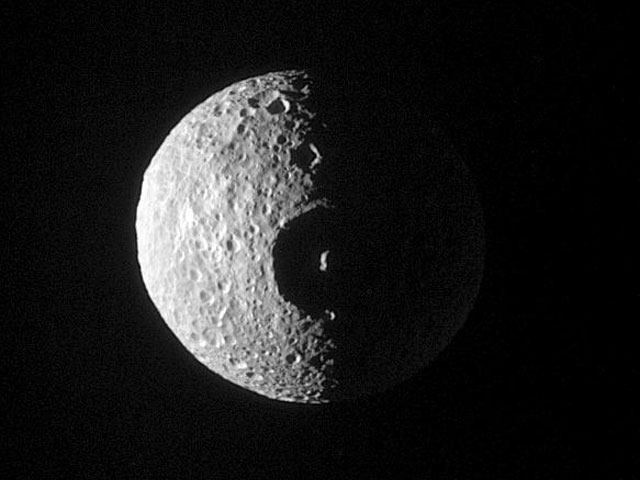
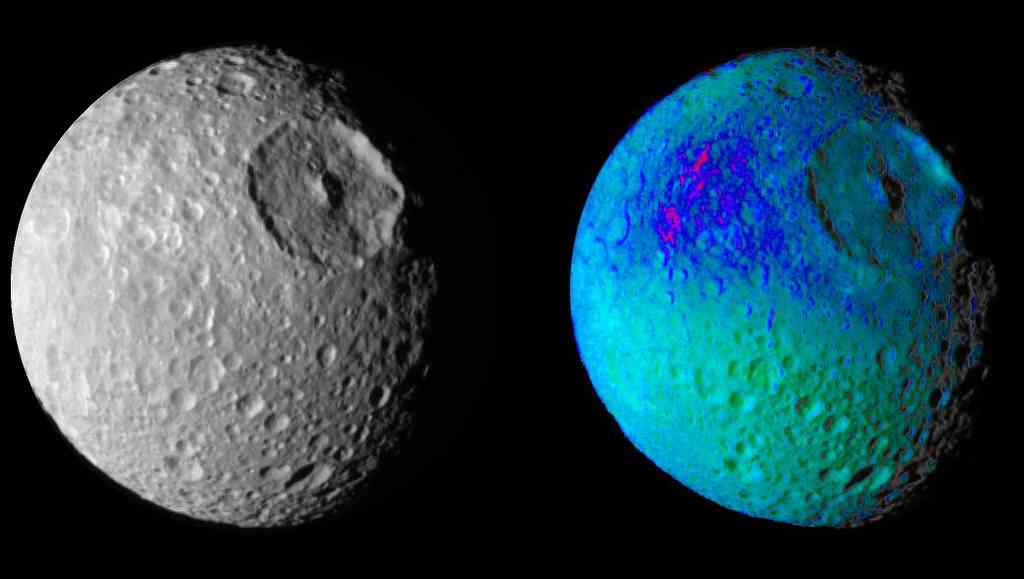
Herschel left an impresion on Mimas.


Spare a thought for Mimas, Suturns moon.

The outer Giants are responsible for life on Earth. Life would never have started, or certainly got as complex, if the outer giants werent hoovering up meteors that otherwise would have slammed into Earth.

We've already seen Shoemaker-Levy 9 hit Jupiter. This is what happened to Mimas.

Scientists think that if this impact had been any bigger Mimas wouldnt have survived. It would have been blown to bits.

Instead we have one of the best impact craters in the Solar System.
It is 130km across and they call it Herschel.

Big, huh. lol