A (fairly) nice and straight forward week so far. One of the joys of being in the same location for so long is that I dont have to worry about getting the trucks in and out on a morning and evening, so can just have a more caretaker role, which involves sitting and watching, with occasional shouting bursts lol, like the poor grip who just chucked an apple core outside right in front of me. I pointed him towards the bin ;)
 When does Mars act like a liquid? Although liquids freeze and evaporate quickly into the thin atmosphere of Mars, persistent winds may make large sand dunes appear to flow and even drip like a liquid. Visible on the above image right are two flat top mesas in southern Mars, where the season is changing from Spring to Summer. A light dome topped hill is also visible on the far left of the image. As winds blow from right to left, flowing sand on and around the hills leaves picturesque streaks. The dark arc-shaped droplets of fine sand are called barchans, and are the interplanetary cousins of similar Earth-based sand forms. Barchans can move intact downwind and can even appear to pass through each other. Over the past few weeks, winds on southern Mars have been kicking up dust and are being watched to see if they escalate into another of Mars' famous planet-scale sand storms.
  Why would clouds appear to be different colors? The reason here is that ice crystals in distant cirrus clouds are acting like little floating prisms. Sometimes known as a fire rainbow for its flame-like appearance, a circumhorizon arc lies parallel to the horizon. For a circumhorizontal arc to be visible, the Sun must be at least 58 degrees high in a sky where cirrus clouds are present. Furthermore, the numerous, flat, hexagonal ice-crystals that compose the cirrus cloud must be aligned horizontally to properly refract sunlight in a collectively similar manner. Therefore, circumhorizontal arcs are quite unusual to see. This circumhorizon display was photographed through a polarized lens above Dublin, Ohio last week.


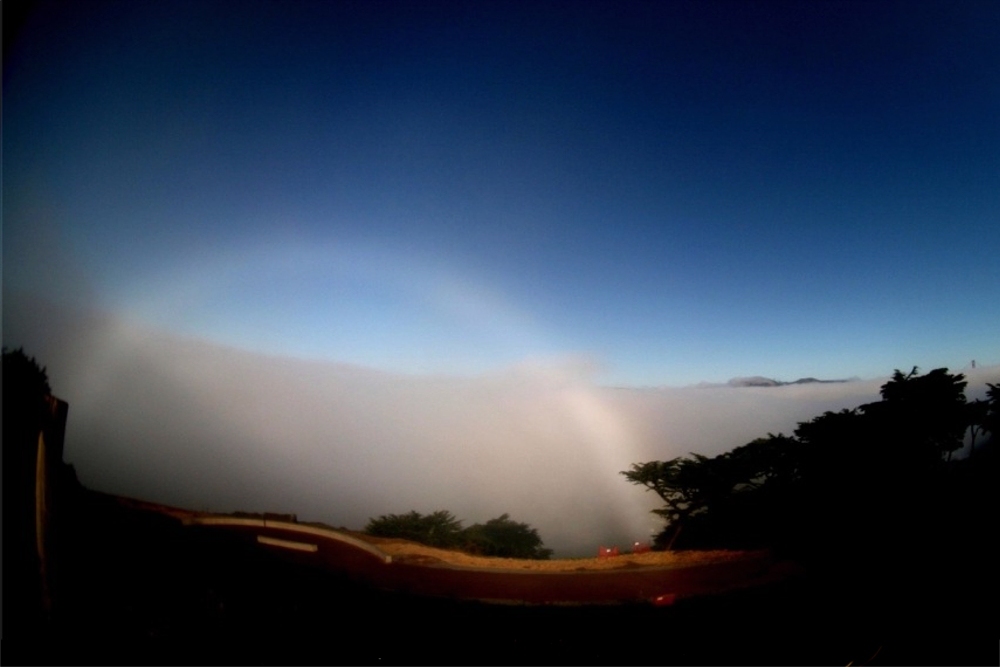
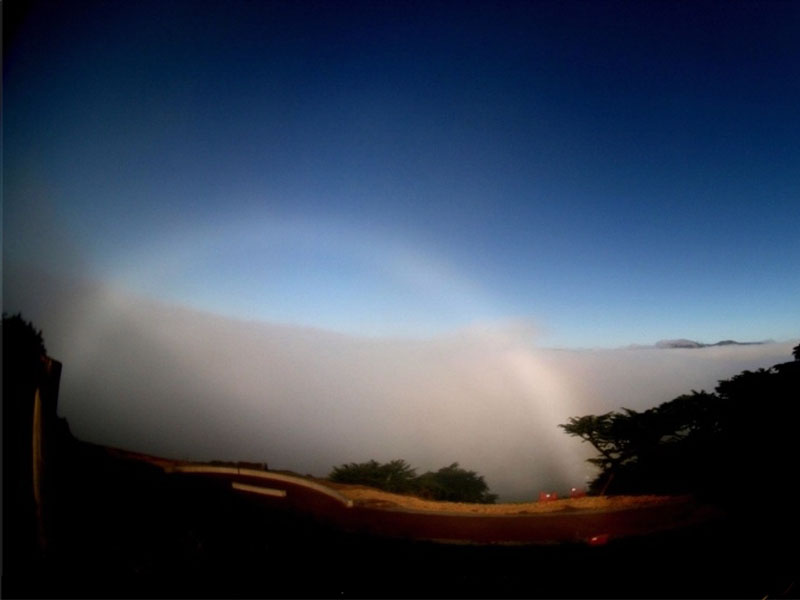 " Is that white arch real? What is being seen is a fogbow, a reflection of sunlight by water drops similar to a rainbow but without the colors. The fog itself is not confined to an arch -- the fog is mostly transparent but relatively uniform. The fogbow shape is created by those drops with the best angle to divert sunlight to the observer. The fogbow's relative lack of colors are caused by the relatively smaller water drops. The drops active above are so small that the quantum mechanical wavelength of light becomes important and smears out colors that would be created by larger rainbow water drops acting like small prisms reflecting sunlight. The above striking image of a fogbow was taken last week with the Sun behind the photographer. Close inspection of the far right of the full image will show one of the two suspension towers of the Golden Gate Bridge in California, USA."