Showing posts with label Solar System. Show all posts

Wednesday, October 15, 2008

Enceladus from Cassini


What a cracking photo! After Europa, Enceladus is my next bet for life in this solar system. Water, water, everywhere.........

"What telling impurities taint the ice plumes of Enceladus? To help answer this question, the robotic Cassini spacecraft dove last week to within 30 kilometers of Saturn's ice-plume emitting moon. At this closest-ever approach, Cassini attempted to sniff and obtain chemical data on particles ejected from Enceladus' regular surface, while at other times Cassini flew right through -- and sampled -- ice geysers directly. Searches in the data for impurity clues in the water-ice dominated plumes and surface ejecta are progressing. Although the main purpose of this flyby was particle analysis, several interesting images are emerging. Visible in the above image, for example, is an unusual gray sheen running vertically up the image center that might be water vapor escaping from surface canyons. Other notable features visible above include vast plains of craterless icy grooves, the day-night terminator across the image left, and an area near the top comparatively rich in craters."

Wednesday, July 16, 2008

Makemake


"Recently discovered Makemake is one of the largest objects known in the outer Solar System. Pronounced MAH-kay MAH-kay, this Kuiper belt object is only slightly smaller than Pluto, orbits the Sun only slightly further out than Pluto, and appears only slightly dimmer than Pluto. Makemake, however, has an orbit much more tilted to the ecliptic plane of the planets than Pluto. Designated 2005 FY9 soon after its discovery by a team led by Mike Brown (Caltech) in 2005, the outer Solar System orb was recently renamed Makemake for the creator of humanity in the Rapa Nui mythology of Easter Island. Additionally, Makemake has been recently classified as a dwarf planet under the new subcategory plutoid, making Makemake the third cataloged plutoid after Pluto and Eris. Makemake is known to be a world somewhat red in appearance, with spectra indicating it is likely covered with frozen methane. Since no images of Makemake's surface yet exist, an artist's illustration originally meant to depict Sedna has been boldly co-opted above to now illustrate Makemake. A hypothetical moon is visualized above nearly in the direction of our distant Sun."

Saturday, July 12, 2008

Southern skies


I've just been chatting with my mate Nick in Australia by the wondrous invention known as Skype. Free voice and video calls with anyone in the world as long as they have a Skype account and a broadband connection. Barely a seconds lag on the line and I'm chatting in real time with Harrogate boy, nee Downunder Insurance demi-god, Nick. Them's some cool beans!

So to honour our boy in the Antipodes, a beautiful picture of the Southern Cross and the sky over the Southern Hemisphere - widely agreed by astronomers to be the more beautiful and interesting of our planets two hemispheres. Boo!

Plus a rather snazzy false-colour image from the surface of Mercury.

"The sprawling Caloris basin on Mercury is one of the solar system's largest impact basins. Created during the early history of the solar system by the impact of a large asteroid-sized body, the basin spans about 1,500 kilometers and is seen in yellowish hues in this enhanced color mosaic. The image data is from the January 14th flyby of the MESSENGER spacecraft, captured with the MDIS instrument. Orange splotches around the basin's perimeter are now thought to be volcanic vents, new evidence that Mercury's smooth plains are indeed lava flows. Other discoveries at Mercury by NASA's MESSENGER mission include evidence that Mercury, like planet Earth, has a global magnetic field generated by a dynamo process in its large core, and that Mercury's surface has contracted significantly as its core cooled."

Tuesday, June 24, 2008

Monthly moon round-up - Dione


Size: 1,120 kilometers - 4th largest moon of Saturn
Orbital radius: 377,400 kilometers - 6.26 Saturn radii - within the E ring
Orbital period: 2.737 days - about 1/6 of Titan's
Discovery: 1684 by Giovanni Domenico Cassini

Dione's globe is dominated by a star-like pattern of bright "wispy terrain" -- or so it appeared from the Voyagers' distant views. It was long speculated that the wispy terrain represented relatively fresh volcanic flows of icy material. Close views from Cassini have revealed that the wisps are not volcanic features at all. They are exposed cliff faces, a terrain created by the fracturing and faulting of Dione's surface. In fact, there are fractures to be seen everywhere on Dione, representing multiple generations of tectonic events. Some slice up craters, while others have craters superimposed on them.

Features on Dione are named for people and places from Virgil's Aeneid, which complements similar Tethys' naming scheme (the Odyssey).

Like Tethys, Dione has little rocks keeping it company in its Lagrange points: Helene occupies the same orbit as Dione, 60 degrees ahead, while Polydeuces occupies the same orbit, 60 degrees behind.

Wednesday, May 21, 2008

Flying over Mars


Please paste this link into your browser http://apod.nasa.gov/apod/ap080519m.html . This is a digital animation of flying over Mars.

Combining data from orbital scans by the Mars Orbiter, and film taken from the ground level by the Mars Rover; they've combined them into a digital film.

As they say in Speed Racer, "Cool beans!"

Saturday, March 29, 2008

Uranus


Its one of the big gas giants, but we never hear much about it, apart from the favourite schoolboy joke about it. A joke even JK Rowling used, to perfection I might add, in one of the Harry Potter book. Notice I've refrained from making any jokes myself about Uranus. I shall leave it up to my readerships foul and twisted minds to do that for me.

But we have some stunning photos now about the Uranian system. Voyager and Hubble have both capture some beauties, both in real light and a mix of infrared and spectrograph.

So here's some photos of the Uranian system. Enjoy.

PS. I love the fact that the moons are named from A Midsummers Nights Dream, and other Shakespeare characters.

Thursday, March 06, 2008

Spring is coming


What are these strange shapes on Mars? Defrosting sand dunes. As spring now dawns on the Northern Hemisphere of Mars, dunes of sand near the pole, as pictured above, are beginning to thaw. The carbon dioxide and water ice actually sublime in the thin atmosphere directly to gas. Thinner regions of ice typically defrost first revealing sand whose darkness soaks in sunlight and accelerates the thaw. The process might even involve sandy jets exploding through the thinning ice. By summer, spots will expand to encompass the entire dunes. The Martian North Pole is ringed by many similar fields of barchan sand dunes, whose strange, smooth arcs are shaped by persistent Martian winds.

Saturday, February 23, 2008

Monday, January 21, 2008

Family Photo Update: Mercury


We haven't had a good picture of cousin Mercury since 1977 (look as his suit!). The MESSENGER space craft is currently orbiting Mercury and taking detailed pictures; the first time since then.

So here is Mercury on 14th January 2008. My hasn't he grown! ;)

Saturday, January 12, 2008

Stunning Jupiter

Two of frankly, the best pictures I have seen in ages were published this week. I thought we had seen most views of Jupiter, but it seems not!!

Why does Jupiter have rings? Jupiter's rings were discovered in 1979 by the passing Voyager 1 spacecraft, but their origin was a mystery. Data from the Galileo spacecraft that orbited Jupiter from 1995 to 2003 later confirmed that these rings were created by meteoroid impacts on small nearby moons. As a small meteoroid strikes tiny Adrastea, for example, it will bore into the moon, vaporize, and explode dirt and dust off into a Jovian orbit. Pictured above is an eclipse of the Sun by Jupiter, as viewed from Galileo. Small dust particles high in Jupiter's atmosphere, as well as the dust particles that compose the rings, can be seen by reflected sunlight.


As the New Horizons spacecraft sweeps through the Solar System, it is taking breathtaking images of the planets. In February of last year, New Horizons passed Jupiter and the ever-active Jovian moon Io. In this montage, Jupiter was captured in three bands of infrared light making the Great Red Spot look white. Complex hurricane-like ovals, swirls, and planet-ringing bands are visible in Jupiter's complex atmosphere. Io is digitally superposed in natural color. Fortuitously, a plume was emanating from Io's volcano Tvashtar. Frost and sulfuric lava cover the volcanic moon, while red-glowing lava is visible beneath the blue sunlight-scattering plume. The robotic New Horizons spacecraft is on track to arrive at Pluto in 2015.

Sunday, December 23, 2007

Space, above and beyond


There's been some fantastic astronomy pictures published in my absence. Here's just a few of them. (Please) click to enlarge.

1. My favourite moon Europa

2. The International Space Station

3. Alborz Mountains in Moonlight

4. Comet McNaught at dawn

5. Saturns rings and its moon Tethys.

Friday, November 23, 2007

Something for the weekend


There were a bunch of quality photos available today, so I thought I would put some up for you.

I keep intending not to publish anymore photos of Auroras, yet I keep coming across fantastic photos of them; and each one better than the last! lol

There is another fantastic close-up of Comet Holmes. And a wonderful shot of Earthrise! Taken my a Japanese probe that is orbitting the Moon right now. Beautiful :)

Have a nice weekend!

Thursday, November 15, 2007

Comet Holmes


We have a comet going through our solar system at the moment - Comet Holmes.

http://www.earthsky.org/article/see-comet-holmes-this-weekend

With the vast array of telescopes and cameras available to us now, we have capture some amazing shots of it.

Enjoy!

Friday, October 05, 2007

I told you it was dangerous out there!


I have often gone on about how powerful the various cosmic rays out in space are. Bursts of energy that are measured in terms greater than we can comprehend. Our Sun churns out more energy in day than all the nuclear energy ever generated on this planet.

The Sun preiodically chucks out lumps of its self into space in whats called a Coronal Mass Ejection (CME). They dont cause us too much trouble as we have a magnetic field and an atmosphere to keep most of the energy out. The energy hit its the force field of our magnetic field, and ripples across it in what we call the Aurora ;)


Please click on this link and play clip on the page: http://antwrp.gsfc.nasa.gov/apod/ap071003.html

What you are watching is a comet run into a Cornal Mass Ejection and having its ten million mile tail ripped off!

I told you it was powerful out there.

Monday, September 10, 2007

Instructions included


Now what the hell is this?

This is Mankinds message to any aliens out there. This, and another like it are imbedded into the Voyager 1 & 2 space probes that were launched into out solar system in the 70's to photograph the outer planets. They did spectaculr work, proving us with the orignal shots of Jupiter, Saturn, Uranus, Neptune, and there moons. It also manages to be the baddie in the original Star Trek movie, when a souped-up Voyager 1 was sent back to Earth as a killer probe (V-Ger).

When the Voyagers had photographed their final missions of Uranus and Neptune, the two probes were still working fine - their power sources still full of juice; so they were left to continue on their present trajectorys and they have continued ever since. They both left out solar system a few years ago and are both in Deep Space on the way to who knows where.

It is a 12 inch record cast on gold-plated copper. On the disk is sounds and images of planet Earth as decided by a pannel of do-gooders in the US in th 70's.

And cast on the back is the directions to Earth, and instructions to aliens on how to listen to our record.

Good stuff!

Friday, May 11, 2007

Moons and Rings


You know I like moons. These fantastic photos show just some of the many, many moons of Saturn and Jupiter.


1. I love this photo! This shows Saturns moon Enceladus creating one of Saturns rings. Like a comet, when the Sun hits the moon, the ice evaporates and creates a tail. Due to Saturns immense gravity the ice vapour follows Enceladus in orbit around the planet. We have never seen this view before because the Sun was behind us. It was only when the Cassini probe flew to the other side of Saturn and looked back, and Enceladus was silloutted could we see this ring creation in action.

2. Saturns moon Epimetheus against the rings.

3. My favourite moon Europa (still the best hope for extra terrestrial life, IMHO) rising over Jupiter.


Niiiice!

Wednesday, April 25, 2007

Hexagonal clouds on Saturn


" Why would clouds form a hexagon on Saturn? Nobody is yet sure. Originally discovered during the Voyager flybys of Saturn in the 1980s, nobody has ever seen anything like it anywhere else in the Solar System. If Saturn's South Pole wasn't strange enough with its rotating vortex, Saturn's North Pole might now be considered even stranger. The bizarre cloud pattern is shown above in a recent infrared image taken by the Saturn-orbiting Cassini spacecraft. The images show the stability of the hexagon even 20 years after Voyager. Movies of Saturn's North Pole show the cloud structure maintaining its hexagonal structure while rotating. Unlike individual clouds appearing like a hexagon on Earth, the Saturn cloud pattern appears to have six well defined sides of nearly equal length. Four Earths could fit inside the hexagon. Although full explanations are not yet available, planetary scientists are sure to continue to study this most unusual cloud formation for quite some time."

Thursday, March 08, 2007

Triton


You know I love moons. This is Neptunes moon Triton, as seen by Voyager 2.

Another cracked chunk of rock, but with ice volcanoes!

Nice.

Sunday, February 25, 2007

The Pale Blue Dot.


This is from a famous speech the legendary author and cosmologist Karl Sagen once gave. It is quite beautiful.

"We succeeded in taking that picture [from deep space], and, if you look at it, you see a dot. That's here. That's home. That's us. On it, everyone you ever heard of, every human being who ever lived, lived out their lives. The aggregate of all our joys and sufferings, thousands of confident religions, ideologies and economic doctrines, every hunter and forager, every hero and coward, every creator and destroyer of civilizations, every king and peasant, every young couple in love, every hopeful child, every mother and father, every inventor and explorer, every teacher of morals, every corrupt politician, every superstar, every supreme leader, every saint and sinner in the history of our species, lived there on a mote of dust, suspended in a sunbeam."

Sunday, September 03, 2006

The Grand Canyon


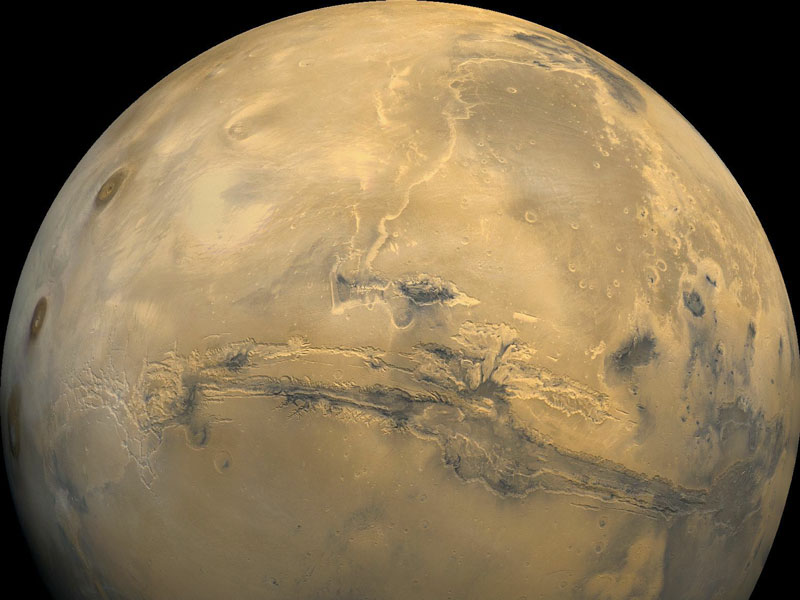
This is Valles Marineris on Mars.

"The Valles Marineris is a system of canyons located just south of the Martian equator. The system is about 4000 km long, and, if on earth, would extend all the way across the United States. The central individual troughs, generally 50 to 100 km wide, merge into a depression as much as 600 km wide. In places the canyon floor reaches a depth of 10 km, 6 to 7 times deeper than the Grand Canyon"

Big, huh?