Showing posts with label Jupiter. Show all posts

Saturday, June 05, 2010

Fireball on Jupiter

A huge fireball has been spotted on Jupiter in yet another collision from space caught on camera and video by amateur astronomers.

The new Jupiter crash occurred on June 3 at 20:31 UT (4:31 p.m. Eastern Time) and was spotted by skywatcher Anthony Wesley in Australia and fellow amateur astronomer Christopher Go in the Philippines.

Wesley's photos show the Jupiter fireball blazing in the atmosphere of the gas giant planet. So far, no visible scar in the clouds has been reported from the event.

Wesley described the event as a "large fireball" on his website, where he posted the photos taken from Broken Hill, Australia.

This new impact on Jupiter comes less than a year after a spectacular crash on July 19, 2009, when what scientist now think was an asteroid about 1,600 feet (500 meters) wide slammed into the planet. That collision created a massive bruise the size of the Pacific Ocean. [Gallery: Jupiter gets smacked.]

It was Wesley, too, who first spotted the July 2009 collision. His observations kicked off an international observation campaign to study the impact site.

Astronomers initially suspected a comet in last year's impact, but announced this week that a rogue asteroid was the most likely culprit.

And Jupiter has been smacked before.

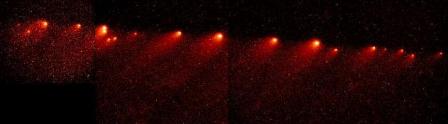
In 1994, the comet Shoemaker-Levy 9 broke into more than 20 pieces and pelted Jupiter repeatedly. At the time, astronomers estimated such impacts could occur on Jupiter every 50 to 250 years. So they were surprised by the July 2009 impact.

Sunday, January 11, 2009

Monthly Moon Round-up: Ganymede


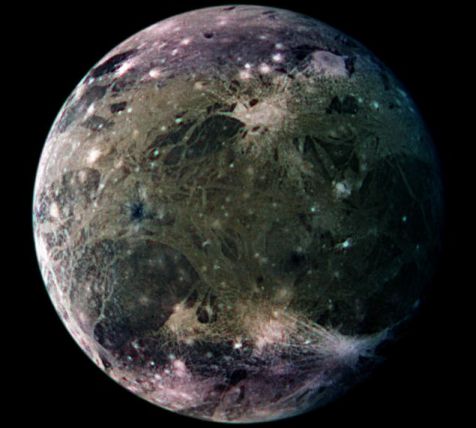
"Ganymede, one of the four Galilean moons of Jupiter, is the largest moon in the Solar System. With a diameter of 5,260 kilometers it is even larger than planets Mercury and Pluto and just over three quarters the size of Mars. Ganymede is locked in synchronous rotation with Jupiter. This detailed mosaic of images from the Galileo spacecraft shows the trailing hemisphere of this planet-sized moon. Speckled with bright young craters, Ganymede's surface shows a mixture of old, dark, cratered terrain and lighter regions laced with grooves and ridges. Ganymede's true colors tend toward subtle browns and grays, but this mosaic's colors have been enhanced to increase surface contrasts. The violet shades extending from the top and bottom are likely due to frost particles in Ganymede's polar regions."

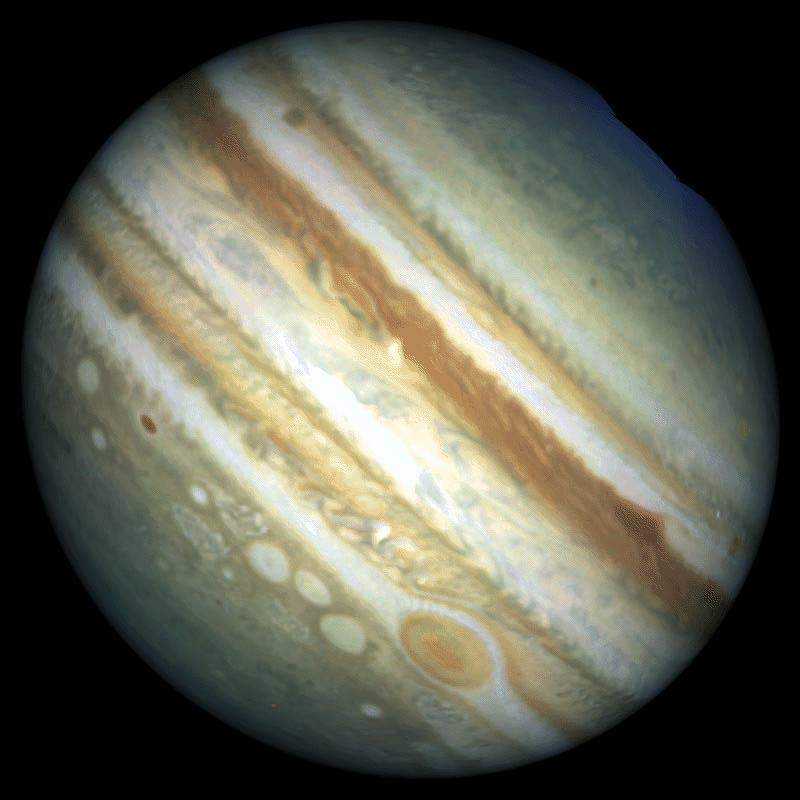
"How hazy is Jupiter's upper atmosphere? To help find out, astronomers deployed the Hubble Space Telescope to watch Jupiter eclipse its moon Ganymede. Although Ganymede circles Jupiter once a week, a particularly useful occultation occurs more rarely. Such an occultation was captured in great visual detail in April 2007. When near Jupiter's limb, Ganymede reflects sunlight though Jupiter's upper atmosphere, allowing astronomers to search for haze by noting a slight dimming at different colors. One result of this investigation was the above spectacular image, where bands of clouds that circle Jupiter are clearly visible, as well as magnificent swirling storm systems such as the Great Red Spot. Ganymede, at the image bottom, also shows noticeable detail on its dark icy surface."

Saturday, January 12, 2008

Stunning Jupiter

Two of frankly, the best pictures I have seen in ages were published this week. I thought we had seen most views of Jupiter, but it seems not!!

Why does Jupiter have rings? Jupiter's rings were discovered in 1979 by the passing Voyager 1 spacecraft, but their origin was a mystery. Data from the Galileo spacecraft that orbited Jupiter from 1995 to 2003 later confirmed that these rings were created by meteoroid impacts on small nearby moons. As a small meteoroid strikes tiny Adrastea, for example, it will bore into the moon, vaporize, and explode dirt and dust off into a Jovian orbit. Pictured above is an eclipse of the Sun by Jupiter, as viewed from Galileo. Small dust particles high in Jupiter's atmosphere, as well as the dust particles that compose the rings, can be seen by reflected sunlight.


As the New Horizons spacecraft sweeps through the Solar System, it is taking breathtaking images of the planets. In February of last year, New Horizons passed Jupiter and the ever-active Jovian moon Io. In this montage, Jupiter was captured in three bands of infrared light making the Great Red Spot look white. Complex hurricane-like ovals, swirls, and planet-ringing bands are visible in Jupiter's complex atmosphere. Io is digitally superposed in natural color. Fortuitously, a plume was emanating from Io's volcano Tvashtar. Frost and sulfuric lava cover the volcanic moon, while red-glowing lava is visible beneath the blue sunlight-scattering plume. The robotic New Horizons spacecraft is on track to arrive at Pluto in 2015.

Monday, October 15, 2007

Its a beautiful universe


I've been away for a few days to Blackpool (dont ask! lol), and it seems a vertiable dearth of beautiful images.

So heres something to feast your eyes on at the start of the working week. Click on them to enlarge. :)

Its all rather pretty out there :D

1. The complexity of Jupiters clouds

2. Ice geysers on Saturns moon Enceladus. The geysers are estimated to be 0 degrees Celcius, but as the planet itself is -200C then it will geyser like crazy.

3. The Whale and the Hockystick galaxies.

4. And the most beautiful photo of an aurora I've ever seen.

Wednesday, May 16, 2007

Io


I told you moons was where its at. Mars is geologically inert (no volcanic activity), Venus is too hot to visit, Mercury is a cinder, and rest are gas giants (because Pluto is no longer a planet!).
Its the vast array of moons that we have where the most spectacular things are happening.


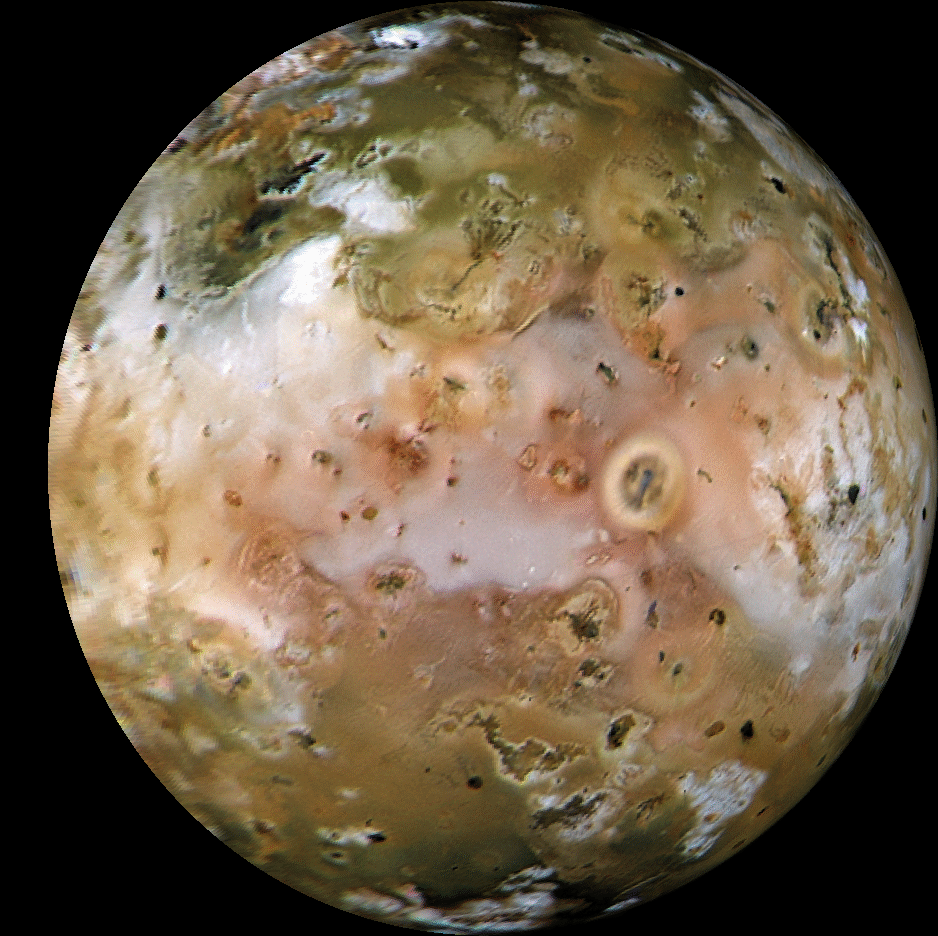
Io, Jupiters moon is a hotbed of activity. Jupiter is playing Io like an accordian. The surface is being pulled upto 250km upwards to Jupiter at its closest orbit, and back down at its furthest orbit. This constant back and forth creates incredible friction inside Io, and as a result it constantly spews sulphur volcanoes. Mapping Io is impossible as the surface never remains the same, due to constant eruptions.

We even caught a volcano on camera. It is estimated that this eruption of sulphur and methane is 500km high.

Cool.

Friday, May 11, 2007

Moons and Rings


You know I like moons. These fantastic photos show just some of the many, many moons of Saturn and Jupiter.


1. I love this photo! This shows Saturns moon Enceladus creating one of Saturns rings. Like a comet, when the Sun hits the moon, the ice evaporates and creates a tail. Due to Saturns immense gravity the ice vapour follows Enceladus in orbit around the planet. We have never seen this view before because the Sun was behind us. It was only when the Cassini probe flew to the other side of Saturn and looked back, and Enceladus was silloutted could we see this ring creation in action.

2. Saturns moon Epimetheus against the rings.

3. My favourite moon Europa (still the best hope for extra terrestrial life, IMHO) rising over Jupiter.


Niiiice!

Sunday, August 13, 2006

Shoemaker-Levy 9


On the 18th July 1994, comet Shoemaker-Levy 9 slams into Jupiter.

"The power and size of the explosions of most fragments far exceeded most predictions. Although the visible flashes were out of sight, in infra-red the huge mushroom clouds, some bigger than the entire Earth, could be seen rising up over the edge of Jupiter. The power of the biggest explosion, that of fragment G, was estimated at 250 million megatons of TNT, 17 billion times bigger than the bomb dropped on Hiroshima in 1945 (yield 15 kilotons). Even the biggest hydrogen bomb ever exploded by mankind, 50 megatons, is tiny by comparison."

Cool, huh?

Arnt we small, lol?

Saturday, July 29, 2006

Mess with Jupiter at your own peril.

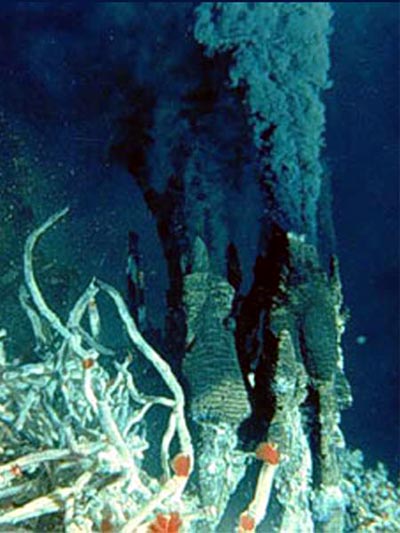
Thermal Vents on Earth


A volcanic eruption on Io. Filmed from Galileo Orbiter


Io.


Ganymede.

Being in Jupiters orbit has a price. For Io, at its closest point to Jupiter in its orbit, the surace of Io is 200 miles higher than when it is orbitting at its furthest point. The constant accordian effect on the moons generates volcanic activity that would end life on earth. The other moons suffer similar fates. Apparently they cant map the surface of Io because it is constantly being re-shaped by all the lava. Not molten rock but sulpher volcanoes!!

When they were photgraphing Ganymede one of the shots had a strange lump on it, it looked almost like another moon rising behind Ganymede. It later turned out it was a volcanic explosion 300 miles high. So big it changed the profile of the moon in that photo. Crazy!!

So tell me there arnt volcanic thermal vents at the bottom on Europa? Eruptions that would have melted the ice, forming seas underneath. And what do what, heat, and chemicals equal? Hey Presto....Life.

Space. Not the final frontier.


A few of my all-time favourite astonomy pictures, including my all-time favourite moon, Europa. What do you mean you dont have a favourite moon? You cant be happy with our own boring moon? lol. It just sits up there doing nothing but regulating our tides. BORING. Now Europa is covered with ice...which means under the ice there will be water (there WILL be geothermal springs under there. If you see what state Io and Ganymede are in as a result of Jupiters gravity and intense radiation you will be in no doubt)...and if you get water, and volcanic chemicals.....HEY PRESTO, you get life :). Why a Europa trip isnt on the top of everyones list of things to do, I dont understand.

Soon (ish) we will send men to Mars, should be in the next 10 years. Its the one good thing Bush as done, although he was only trying to emulate JFK. He aint half that Prez.

But the big thing on my horizon is the Planetary Finder. WHich is a series of telescopes linked by laser or something else. It would be apparently stong enough see actual planets orbitting distant stars. Now that would be cool!! http://www.jpl.nasa.gov/missions/proposed/tpf.html

And notice I havent used the word Alien even once, lol.