
Wow!! Snazzy, or what?! Please hurry up and make this commercially available.
Showing posts with label technology. Show all posts
Showing posts with label technology. Show all posts
Wednesday, March 03, 2010


Sunday, December 20, 2009
Super Mario bacteria

If you could engineer bio-luminescent bacteria to glow certain colors, don't try to tell me you wouldn't try to create Mario's iconic Super Mario Bros sprite.
Let's say you were a member of a team that entered the International Genetically Engineered Machine competition (iGEM), and were given the task of creating art with biological components - specifically, luminescent bacterial cultures. What would you do?
If you were a member of the team from the nanobiology laboratories at the University of Osaka, apparently you would shape said bacteria into the iconic sprite of the world's most famous plumber, as seen here. The bacteria are genetically engineered to "express fluorescent proteins and carotenoid pigments to create works of art," which is fancy science talk for "They make the bacteria glow pretty colors."
The New Scientist has some more of the pieces, and while some of them are mind-blowingly gorgeous and impressive (I'm particular to the photo of Albert Einstein), none of them are Mario. So clearly, the Osakans win.
Wednesday, December 09, 2009
Pointless

(C) By Harry Wallop, Consumer Affairs Editor, The Guardian
The Ultramarinum Marine watch, made by Swiss company Horus, promises to give its owners "the power of time". By pressing a button, the company promises, "the owner can play with the seconds, minutes and hours and make them follow the pace of his or her choice, then return to current time at any point."
The idea is that millionaires can enjoy the illusion of being in a slower or faster world, by making their watch faster or slower. If they are sunbathing and want to pretend the world has stopped moving, they can even stop the time. When they need to return to the real world – or find out the correct time – they push a button and the watch returns to normal.
Gadget experts are amused if a little bit confused by the watch, whose design has been inspired by the 1920s steam yacht SS Delphine.
Kat Hannaford, the contributing editor of Gizmodo, said: "This is clearly aimed at yachtsmen. But there are few places where accurate time is more important than when you are at sea and you need to know the time of the tides and the setting of the sun.
"And I am guessing anyone who has £400,000 to spend on watch is probably glued to their Blackberry all day anyway. The watch is going to appeal to owners of super yachts that never leave their moorings in the Monte Carlo harbour, rather than true sailors."
The watch face is made of teak, titanium and the mechanism inside the watch includes 45 rubies. It is water resistant to 100 meters and shockproof. The strap is made of canvas and leather.
The speeding up and slowing down mechanism is controlled by "a marine tourbillion function".
The founder of Horus, Andre Grossmann, who designed the £410,000 luxury item, defended a watch that didn't tell the correct time.
He said: "It took four years to create this breathtaking time-piece. We used avant-garde materials and revolutionary technologies to create a watch with a time-control system. I am really pleased to be able to offer people the possibility of controlling time. That, for me, is the very essence of true luxury. What could be more precious than time?"
Anyone won over by the Ultramarinum Marine watch can buy it from one of Horus's three shops situated in Montreux Switzerland, Monaco and Abu Dhabi.
Thursday, November 19, 2009
3D Building Project
From Netherlands-based design firm, NuFormer Digital Media, comes a new way of projecting three-dimensional images onto a building exterior. Custom-designed to fit any building façade and scale up to any size, the video mapped objects are made visible by a set of powerful projectors. Without physically constructing new architecture or permanently altering the streetscape, NuFormer hardware/software technology enables users to transform an outdoor public space into a virtual yet live experience. Consider the possibilities to communicate, entertain, educate. Think of how 3-D projections can be used for advertising, product launches, conferences, concerts, festivals. This is a whole new medium waiting to be tapped.
Projection on Buildings from NuFormer Digital Media on Vimeo.
Wednesday, November 18, 2009
Friday, July 10, 2009
Minority Report
My mate Terry showed me this clip on Youtube. The future is here. Watch and drool lol
Monday, February 09, 2009
Teleportation aka Beam Me Up, Scotty

Warning: Big reading ahead!
Scientists have come a bit closer to achieving the "Star Trek" feat of teleportation.
No one is galaxy-hopping, or even beaming people around, but for the first time, information has been teleported between two separate atoms across a distance of a meter — about a yard.
This is a significant milestone in a field known as quantum information processing, said Christopher Monroe of the Joint Quantum Institute at the University of Maryland, who led the effort.

Teleportation is one of nature's most mysterious forms of transport: Quantum information, such as the spin of a particle or the polarization of a photon, is transferred from one place to another, without traveling through any physical medium.
It has previously been achieved between photons (a unit, or quantum, of electromagnetic radiation, such as light) over very large distances, between photons and ensembles of atoms, and between two nearby atoms through the intermediary action of a third.
None of those, however, provides a feasible means of holding and managing quantum information over long distances.

Now the JQI team, along with colleagues at the University of Michigan, has succeeded in teleporting a quantum state directly from one atom to another over a meter.
That capability is necessary for workable quantum information systems because they will require memory storage at both the sending and receiving ends of the transmission.
In the Jan. 23 issue of the journal Science, the scientists report that, by using their protocol, atom-to-atom teleported information can be recovered with perfect accuracy about 90 percent of the time — and that figure can be improved.
"Our system has the potential to form the basis for a large-scale 'quantum repeater' that can network quantum memories over vast distances," Monroe said. "Moreover, our methods can be used in conjunction with quantum bit operations to create a key component needed for quantum computation."
A quantum computer could perform certain tasks, such as encryption-related calculations and searches of giant databases, considerably faster than conventional machines. The effort to devise a working model is a matter of intense interest worldwide.

Teleportation and entanglement
Physicist Richard Feynman is quoted as having said that "if you think you understand quantum mechanics, you don't understand quantum mechanics."
Or sometimes he is cited thusly: "I think I can safely say that nobody understand quantum mechanics."

Nonetheless, here is how the University of Maryland describes Monroe's work.
Teleportation works because of a remarkable quantum phenomenon called entanglement which only occurs on the atomic and subatomic scale.
Once two objects are put in an entangled state, their properties are inextricably entwined.
Although those properties are inherently unknowable until a measurement is made, measuring either one of the objects instantly determines the characteristics of the other, no matter how far apart they are.
The JQI team set out to entangle the quantum states of two individual ytterbium ions so that information embodied in the condition of one could be teleported to the other.
Each ion was isolated in a separate high-vacuum trap, suspended in an invisible cage of electromagnetic fields and surrounded by metal electrodes.

The researchers identified two readily discernible ground (lowest energy) states of the ions that would serve as the alternative "bit" values of an atomic quantum bit, or qubit.
Conventional electronic bits (short for binary digits), such as those in a personal computer, are always in one of two states: off or on, 0 or 1, high or low voltage, etc.
Quantum bits, however, can be in some combination, called a "superposition," of both states at the same time, like a coin that is simultaneously heads and tails — until a measurement is made.
It is this phenomenon that gives quantum computation its extraordinary power.

At the start of the experimental process, each ion (designated A and B) is initialized in a given ground state.
Then ion A is irradiated with a specially tailored microwave burst from one of its cage electrodes, placing the ion in some desired superposition of the two qubit states — in effect "writing" into "memory" the information to be teleported.
Immediately thereafter, both ions are excited by a picosecond (one trillionth of a second) laser pulse.
The pulse duration is so short that each ion emits only a single photon as it sheds the energy gained by the laser and falls back to one or the other of the two qubit ground states.
Depending on which one it falls into, the ion emits one of two kinds of photons of slightly different wavelengths (designated red and blue) that correspond to the two atomic qubit states.
It is the relationship between those photons that will eventually provide the telltale signal that entanglement has occurred.

Beamsplitter encounter
Each emitted photon is captured by a lens, routed to a separate strand of fiber-optic cable, and carried to a 50-50 beam splitter where it is equally probable for the photon to pass straight through the splitter or to be reflected.
On either side of the beam splitter are detectors that can record the arrival of a single photon.
Before it reaches the beam splitter, each photon is in an unknowable superposition of states. After encountering the beam splitter, however, each takes on specific characteristics.
As a result, for each pair of photons, four color combinations are possible — blue-blue, red-red, blue-red and red-blue — as well as one of two polarizations: horizontal or vertical.
In nearly all of those variations, the photons either cancel each other out or both end up in the same detector.
But there is one — and only one — combination in which both detectors will record a photon at exactly the same time.
In that case, however, it is physically impossible to tell which ion produced which photon because it cannot be known whether the photon arriving at a detector passed through the beam splitter or was reflected by it.
Thanks to the peculiar laws of quantum mechanics, that inherent uncertainty projects the ions into an entangled state.

That is, each ion is in a superposition of the two possible qubit states.
The simultaneous detection of photons at the detectors does not occur often, so the laser stimulus and photon emission process has to be repeated many thousands of times per second.
But when a photon appears in each detector, it is an unambiguous signature of entanglement between the ions.
When an entangled condition is identified, the scientists immediately take a measurement of ion A. The act of measurement forces it out of superposition and into a definite condition: one of the two qubit states.
But because ion A's state is irreversibly tied to ion B's, the measurement also forces B into the complementary state.
Depending on which state ion A is found in, the researchers now know precisely what kind of microwave pulse to apply to ion B in order to recover the exact information that had been written to ion A by the original microwave burst.
Doing so results in the accurate teleportation of the information.
Teleportation vs. other communications
What distinguishes this outcome as teleportation, rather than any other form of communication, is that no information pertaining to the original memory actually passes between ion A and ion B.

Instead, the information disappears when ion A is measured and reappears when the microwave pulse is applied to ion B.
"One particularly attractive aspect of our method is that it combines the unique advantages of both photons and atoms," says Monroe. "Photons are ideal for transferring information fast over long distances, whereas atoms offer a valuable medium for long-lived quantum memory ... Also, the teleportation of quantum information in this way could form the basis of a new type of quantum internet that could outperform any conventional type of classical network for certain tasks."
The work was supported by the Intelligence Advanced Research Project Activity program under U.S. Army Research Office contract, the National Science Foundation (NSF) Physics at the Information Frontier Program, and the NSF Physics Frontier Center at the Joint Quantum Institute.
Friday, January 16, 2009
Wide boy


*drools*
THE WIDE BOYS at Philips have really pushed the boat out, introducing the first extra, extra wide cinema-proportioned LCD television.
The new Cinema 21:9 sports a whopping 56" screen in the 21:9 aspect ratio, allowing movies in the 2.39:1 format to completely fill the screen, rather than lopping bits off or distorting the image.
Philip's big screen also comes with Ambilight Spectra tech around the borders and the firm reckons its technology can convert even regular 16:9 content from TV broadcasts and games consoles to a format for the super wide screen.
Saturday, September 27, 2008
The Corpus Clock

Prof Stephen Hawking is to unveil a remarkable £1 million clock with no hands that pays tribute to the world's greatest clockmaker.
One clock made by the legendary John Harrison, the pioneer of longitude, took 36 years to build and he was still calibrating it when he died at his home in London on March 24, 1776, his 83rd birthday.
The Corpus Clock has been invented and designed by Dr John Taylor for Corpus Christi College Cambridge for the exterior of the college's new library building.

It will be unveiled on 19 September by Prof Stephen Hawking, cosmologist and author of the global bestseller, A Brief History of Time.
Dr Taylor, an inventor and horologist who studied at the College in the 1950s has put £1 million of his own money and five years into the project.
"One of my heroes is John Harrison," he says.
Of Harrison's many innovations, he came up with the 'grasshopper escapement', explained Dr Taylor, referring to the device used by Harrison to turn rotational motion into a pendulum motion for timekeeping.
"No one knows how a grasshopper escapement works, so I decided to turn the clock inside out and, instead of making the escape wheel 35 mm across and hidden in the case, it is 1.5 m across and visible with the grasshopper escapement around the outside," said Dr Taylor.
He calls the new version of the escapement a 'Chronophage' (time-eater) - "a fearsome beast which drives the clock, literally "eating away time".

It is the largest Grasshopper escapement of any clock in the world.
The Chronophage "hypnotises the watcher with its perpetual motion, punctuated by an extraordinary repertoire of slow blinks, jaw-snaps and stings from its tail," says Dr Taylor.
The Corpus Clock, a true mechanical mechanism, which is wound up by an electric motor, has no hands. "It is a new way to show time, with light," said Dr Taylor.
The clock has no digital numbers, either, but instead a series of slits cut into the face, each a tenth of a degree across.
Blue LED lights are arranged behind the slits, and 60 quarter inch lenses, so that when the escape wheel moves, a series of rapidly darting lights runs in concentric circles to mark passing seconds, and pause at the correct hour and minute.
What appears to be lights flashing in sequence are actually controlled mechanically, using the same principle as a zoetrope, the old fashioned way to view a moving image through slits. The total wattage used by the clock is less than that of three 60 watt bulbs.

Its massive round face, nearly five feet in diameter, was engineered from a single sheet of stainless steel, the mouldings - like a series of waves rippling outwards - were blasted into place by precisely-controlled explosions under water. On the hour, a chain drops into a wooden coffin hidden behind the clock "to remind us of our mortality," he said.
The clock also plays tricks on the observer, seeming occasionally to pause, run unevenly and even go backwards. All this is achieved through mechanics rather than computer programming.
Harrison used his clocks as time standards for the marine chronometers he had pioneered to deliver accuracy great enough to allow the determination of longitude at sea.
There have been few significant advances in the mechanical clock since Harrison went against the grain of contemporary thinking by using large pendulum swings, enlarging the pendulum's "dominion" to reduce errors.
Among Harrison's many remarkable innovations was the gridiron mechanism, consisting of alternating brass and iron rods assembled so that expansion and contraction rates cancelled each other out as the chronometer moved from the tropics to colder climes.
He was also the inventor of the first caged roller bearing, the father of the ball bearing, in his last clock. Over 100 ball bearings are used in the Corpus clock.
Thursday, September 11, 2008
The God Particle

This is a quick post to to commemorate the switching on the the Large Hydron Collider in Cern, Switzerland. What a cool piece of kit they've built. All to try and find the elusive Higgs Boson particle, also known as the God Particle.
I can't wait to see what they find!

"Nestling in the foothills of the Alps is Europe's largest laboratory, the European Centre for Nuclear Research, or Cern.
With its vast labyrinth of tunnels and equipment stretching for miles, the complex has the feel of a cathedral to science.
And now the scientists here have embarked on their biggest experiment ever, the hunt for a particle which gave the universe its form.
Its scientific name is the Higgs Boson, but because it is so fundamental in shaping the universe, others have called it the God particle.

It is a particle that is supposed to endow other fundamental particles with mass. Without it there would be no gravity, no universe as we know it - no "let there be light" moment.
No-one has seen it, but physicists have invoked it because it is the simplest explanation for how the universe evolved.
Most physicists are instinctively drawn towards theories with a simple elegance.
Reverend Sir John Polkinghorne used to be a theoretical physicist and worked with Professor Peter Higgs, after whom the God particle was named.

Professor Polkinghorne went on to become an Anglican priest. He believes the equations which describe the way sub-atomic particles interact contain a natural beauty in which some find a spark of divinity.
He said: "Physicists are deeply impressed with the order of the world. It is rationally beautiful and structured, and the feeling that there is a mind behind it is a very natural feeling to have."
It is not the first time that a scientific study of the universe has inspired awe and wonder.
The crew of Apollo 8 were so moved by their experience, they felt moved to read passages from the Book of Genesis as they orbited the moon on Christmas Eve in 1968.
US physicists Richard Feynman and George Smoot both described their Nobel Prize-winning insights into the behaviour of subatomic particles and the detection of the Cosmic Background Radiation as looking "unto the face of God".

Professor Polkinghorne understands why such glimpses into the underlying reality of the universe can provoke such reactions.
He said: "I think the feeling of wonder, which is very fundamental to the experience of physicists - the way they see structure in the world - is fundamentally a religious experience, whether people recognise it as such or not.
"And I think it is actually a tacit, sometimes explicit, worship of the creator."
Many of the physicists here are not religious and would disagree with Professor Polkinghorne's view.
For them their buzz is an intellectual rather than religious one. "
Saturday, July 12, 2008
Southern skies

I've just been chatting with my mate Nick in Australia by the wondrous invention known as Skype. Free voice and video calls with anyone in the world as long as they have a Skype account and a broadband connection. Barely a seconds lag on the line and I'm chatting in real time with Harrogate boy, nee Downunder Insurance demi-god, Nick. Them's some cool beans!
So to honour our boy in the Antipodes, a beautiful picture of the Southern Cross and the sky over the Southern Hemisphere - widely agreed by astronomers to be the more beautiful and interesting of our planets two hemispheres. Boo!
Plus a rather snazzy false-colour image from the surface of Mercury.

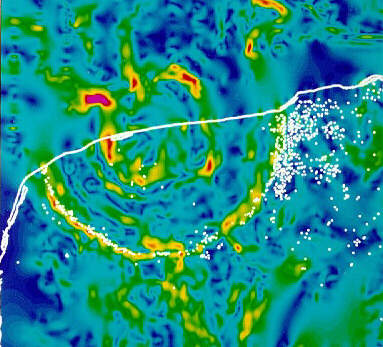
"The sprawling Caloris basin on Mercury is one of the solar system's largest impact basins. Created during the early history of the solar system by the impact of a large asteroid-sized body, the basin spans about 1,500 kilometers and is seen in yellowish hues in this enhanced color mosaic. The image data is from the January 14th flyby of the MESSENGER spacecraft, captured with the MDIS instrument. Orange splotches around the basin's perimeter are now thought to be volcanic vents, new evidence that Mercury's smooth plains are indeed lava flows. Other discoveries at Mercury by NASA's MESSENGER mission include evidence that Mercury, like planet Earth, has a global magnetic field generated by a dynamo process in its large core, and that Mercury's surface has contracted significantly as its core cooled."
Sunday, June 01, 2008
X Box adverts
You may remember the famous X-Box advert where a baby was born, flies through the air while aging, then crashes into a grave as an old man. Life's too short, play more!
I came across a couple of others that I hadn't seen before on Youtube. The first one was banned apparently. I can see why they banned it, but it just made me laugh.
Pretty clever anyway, but possibly not for the easily offended! lol
I came across a couple of others that I hadn't seen before on Youtube. The first one was banned apparently. I can see why they banned it, but it just made me laugh.
Pretty clever anyway, but possibly not for the easily offended! lol
Tuesday, May 27, 2008
The Telectroscope


LONDON (AFP) - An arresting new artistic landmark is drawing crowds in London and New York, intrigued at being able to wave to each other through what is teasingly presented as a a huge Trans Atlantic tunnel.
From its London end next to City Hall on the south bank of the River Thames, tourists and locals can see people at the other end of the Telectroscope, by the Brooklyn Bridge in New York.
Tourists tend to wave or hold up signs reading "Hello from London" to people at the other end of the device, which emerges from the ground like a giant tunnel breaking through the surface after passing under the Atlantic.

But those behind the device -- which is understood to rely on more 21st-century technology to relay real-time images -- say it could serve more useful purposes.
"There are all sorts of possibilities -- you could arrange to meet friends in New York or even propose marriage down it," said Nicky Webb, head of the devices' production company, Artichoke.

With a name which sounds like something from a 1950s science fiction novel, the Telectroscope is the brainchild of 53-year-old British artist, Paul St George.
The website publicising his device, which opened to the public this month, includes spoof diagrams of how the "tunnel" was built, and explaining how a system of mirrors brings the images from either end.

Telling an imaginative tale of how his great-grandfather began the Trans Atlantic project, there is even a picture of the artist with shovel in hand in an underground tunnel.

"Hardly anyone knows that a secret tunnel runs deep beneath the Atlantic Ocean. In May 2008, more than a century after it was begun, the tunnel has finally been completed," it says.

More mundanely, the Telectroscope is thought to use a broadband Internet connection to provide high-resolution video of those looking into it, for a charge of one pound (two dollars, 1.25 euros) at the London end.

Wednesday, May 14, 2008
Useless crap I must own one day # 47

Thanks to the good folk at Empireonline, I now have discovered another thing I would love to own if I didn't have bills to pay :D
"Okay, it's not news per-se but we have to make you aware of possibly the greatest piece of Star Wars-related tat ever created - the Wesco Star Wars R2-D2 Talking Ice Bucket With Han Solo Carbonite Ice Tray.
Yes that's right, for only £16.99, you could get your hands on a recpticle that re-creates the beeps and whistles of C-3PO's hetero life partner and a drink-cooling facsimilie of the Millennium Falcon owner's frozen grave. File under usless but awesome"
But even this pales into insignificance by the sheer awesomeness of the item at #1 - should I ever get some nice playing with cash and I've already bought a car, house, and had 3 holidays! lol
Wednesday, August 22, 2007
Technophilia
Technophilia is, in its simplest definition, a strong enthusiasm for technology, especially newer technologies such as computers, the Internet, cell phones and home theater. It is used in sociology when examining the interaction of individuals with their society, especially contrasted with technophobia. *Wikipedia

My Laptop died last week. The C driev started making funny noises (which is never a good sign). I could have bought a nice spanky new one, but I have been spending money like its going out of fasion, and thats NOT a good thing!
The cheapest repair guys messed me around about picking it up, and after 2 days I got sick of waiting for them and called another company to pick it. Of course the first lot then turned up 50 minutes later. I had to shout at them to get them to go away!
The new company put a new 100 gig hard drive, and operating system and delivered it back to me 2 days later for £150 in total. Bargin!
But it was shocking how much I missed being able to go online. All the websites I visit, all my emails! It was like having an arm cut off. Sad really.
How ever did we manage before mobile phones and PC's. Very well, if I remember! lol.

Thursday, May 17, 2007
My new TV (or the story of the boy who went shopping on Ebay when ver' ver' drunk!)
 So there I am, surfing Ebay at 2.oo am after a heavy cards night when I receive an email from Ebay saying "Have you thought about a new TV?"
Well, who hasnt? Especially when I have just been paid £28,000.
So I am trawling through Ebay pages for new HD Plasma TV's when I come across this bargin. Ex display, knock on the corner, 50" HD flat screen plasma TV; £559 or Best Offer. So I type £500 and go to bed.
Next day a another email. "Congratulations your bid was accepted. You are the winner". I had actually forgotten about the night before so I have a small funny turn. But now it is here, and it is massive! I am now HD ready, and as anyone in the UK knowns we will all have to be in the next 2 years, as they are turning off the anologue signal.
Horray, I have a massive TV!!!
Saturday, January 06, 2007
Camera Phones


 These new mobilephone
cameras are great. You can capture amazing pictures instanly. Cool stuff!
So here are a few photos that were on my phone. Includes a Catherine Wheel at my brothers Bonfire Night party, A straight Flush I had in poker (surely the most beautiful thing ever!), and a couple of sunsets taken from my car when driving, lol
Sunday, September 24, 2006
3D Poker

Sorry I havent posted for a while, its been a busy week.
Work has been hellish, and I've been playing a bit of poker when I get home.
I' ve discovered a new poker site. It is called PKR and it is fully 3D!!! This may not seem much, but it is truely the next step forward in this sort of personal computer interface. Its not just restricted just to poker.
 Although all the recent poker sites that have sprung up are interactive in realtime, PKR adds a truly new dimension as you can customise your avatar/image just like in The SIMS, But as well as realistic looks, movements, and backgrounds, PKR offers you about 30 voice commands and movments. There are the usual niceties like Nice Hand, Thank You, Hi, Goodbye, and Unlucky. But there are also many other fantastic little florishes that you do can use like Chicken (you cluck!), Fan (where you fan yourself theatrically and say "Im feeling the heat"), Cry, Laugh Out Loud, Laugh My *** Off, Cheer, Thumbs Up, and my two favourites Dude! (where you do the cheesy American Bullhorns with your fingers), and Dance (where you do your favourite dance at the table). All off these enhancements really do enhance the playing experience where you tease and josh with your playing mates in realtime.
But it is only a matter of time before our online persona (like Teamwak) will have an avatar that will be able to interact with businesses. You could conduct a virtual interview with an almost perfect virtual human.
Interesting times
Monday, September 18, 2006
Home

So how will we know if we have found life?
Scientists can tell the composition of a planets atmosphere by how light is refracted by it. Different chemicals refract light differently. They call it spectromentry. If a planet had an oxygen atmosphere, or if there was methene in the atmosphere (from living creatures), it would have a distinctive signature that would be readable through a spectrograph.
Knowing this, the good folks at NASA figured they had a good idea what Earth should look like. When they launched the first probe they sent that had a spectrograph on it, they pointed it back at Earth.
It looked just how they thought it would.
Now all astonomers are searching for a new Holy Grail, a planet that has the distinct signature of a planet that carrys Life.
:)
Tuesday, August 29, 2006
Earths first Spaceport?

Sooner or later, we gotta get of this planet. Me thinks sooner, judging reports about global warming and the on-coming War of the Cultures.
Over-population and the usage of our natural resources means that we must find some resources (and even somewhere else to live) before Earth has another Extinction Level Event (ELE). We know a giant rock is coming to change the order of things. It has happened 5 times we know of already. The dinosuar event, 65 million years ago in the Chixalub in Mexico is just the fifth ELE that they know of.

And of course I havent mentioned Super Volcanoes, Global Plagues, Ice Ages, and good old fashioned Thermal Nuclear Death.
sings "We gotta get out of this place". But how?
It is actually really fuel intensive to get of this planet. So much of a rockets fuel is just needed to break the Earths atmospere. You probably couldnt launch a vessel that was meant to go deep space and back again with conventional rocket fuel. It would probably weigh too much. Thats why they dont paint the fuel cells on the shuttle. The extra weight would mean extra fuel to cover it, and even more fuel to cover the extra weight of the extra fuel! phew!
So if you could launch from somewhere where you didnt have to break the Earths atmosphere, you could take so much extra fuel with you for your deepspace exploring or mining trip! Nice :)
And finally, what is the main componant of rocket fuel? Hydrogen, the H in H2O.
Which brings us to that magnificent photo from the Mars Exress showing a crater at the north pole of Mars full of water ice. It is about 10km across and about 200/400 meters thick. And its not the only crater at the pole. Concieivably, you could build a base at the poles of Mars, build a machine that converts water into Hydrogen fuel, and launch missions from there.
Many years in the future, I fear; but we have the technology now, not the political will.
Peace out.
Subscribe to:
Posts (Atom)


