Showing posts with label Optical effects. Show all posts

Thursday, June 19, 2008

Sundogs and Pyramid Ice Halos


Eh?

What if the atmosphere above you became one gigantic lens? This actually happens when a nearly transparent sheet of pyramid shaped ice crystals falls from the sky in a common orientation. These ice-crystals act together like millions of miniature ice mirrors, with external and internal reflections from different faces creating arcs and halos of different radii. An amazing display of pyramid ice crystal halos was captured on June 5 above Tampere, Finland. Visible above are very unusual sun halos of 9, 18, 20, 23, and 24 degrees. In contrast, thin and flat falling ice crystals will produce a halo of 22 degrees only. The high clouds containing the ice crystals are faintly visible, as are some sundogs. The usual Sun image was covered behind a light post, and the above image was significantly digitally sharpened. It is not currently known how large areas of nearly uniform pyramidal ice crystals form.


What if you woke up one morning and saw more than one Sun in the sky? Most probably, you would be seeing sundogs, extra-images of the Sun created by falling ice-crystals in the Earth's atmosphere. As water freezes in the atmosphere, small, flat, six-sided, ice crystals might be formed. As these crystals flutter to the ground, much time is spent with their faces flat, parallel to the ground. An observer may pass through the same plane as many of the falling ice crystals near sunrise or sunset. During this alignment, each crystal can act like a miniature lens, refracting sunlight into our view and creating parhelia, the technical term for sundogs. Sundogs were photographed here in a cloudy sky above the Very Large Array of radio telescopes. The real Sun is near the center above the train tracks. A bright sundog is visible on the far right, and a dim one on the far left. Ice-crystals can create other strange illusions of the Sun and Moon including halos and pillars

Tuesday, June 10, 2008

A Fire Rainbow


"What is that inverted rainbow in the sky? Sometimes known as a fire rainbow for its flame-like appearance, a circumhorizon arc is created by ice, not fire. For a circumhorizon arc to be visible, the Sun must be at least 58 degrees high in a sky where cirrus clouds are present. Furthermore, the numerous, flat, hexagonal ice-crystals that compose the cirrus cloud must be aligned horizontally to properly refract sunlight like a single gigantic prism. Therefore, circumhorizon arcs are quite unusual to see. Pictured above, however, a rare fire rainbow was captured above trees in Whiting, New Jersey, USA in late May."

Monday, May 12, 2008

The Gegenschein and the Glory


So what the hell is the gegenschein, and what the hell is the glory?

"Is the night sky darkest in the direction opposite the Sun? No. In fact, a rarely discernable faint glow known as the gegenschein (German for "counter glow") can be seen 180 degrees around from the Sun in an extremely dark sky. The gegenschein is sunlight back-scattered off small interplanetary dust particles. These dust particles are millimeter sized splinters from asteroids and orbit in the ecliptic plane of the planets. Pictured above from last October is one of the most spectacular pictures of the gegenschein yet taken. Here a deep exposure of an extremely dark sky over Paranal Observatory in Chile shows the gegenschein so clearly that even a surrounding glow is visible. In the foreground are several of the European Southern Observatory's Very Large Telescopes, while notable background objects include the Andromeda galaxy toward the lower left and the Pleiades star cluster just above the horizon. The gegenschein is distinguished from zodiacal light near the Sun by the high angle of reflection. During the day, a phenomenon similar to the gegenschein called the glory can be seen in reflecting air or clouds opposite the Sun from an airplane."

"Looking out the window of an airplane, you might be lucky enough to see "the glory" in the direction directly opposite the Sun. Before airplanes, the phenomenon, known to some as the heiligenschein or the Specter of the Brocken, was sometimes seen from mountaintops. There, when conditions were right, one could look away from the Sun and see what appeared to be the shadow of a giant surrounded by a bright halo. The giant turns out to be the observer, as in the modern version a silhouette of an plane frequently occupies the glory's center. Pictured above, several concentric rings of the glory were photographed. The cause of the glory has only been understood recently and is relatively complex. Briefly, small droplets of water reflect, refract, and diffract sunlight backwards towards the Sun. The phenomenon has similar counterparts in other branches of science including astronomy, where the looking out from the Earth in the direction opposite the Sun yields a bright spot called the gegenschein."

Thursday, November 16, 2006

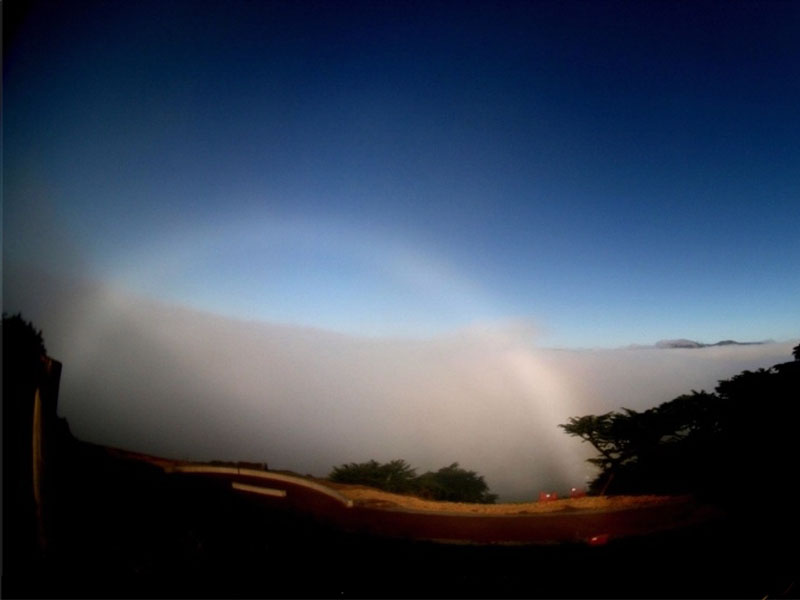
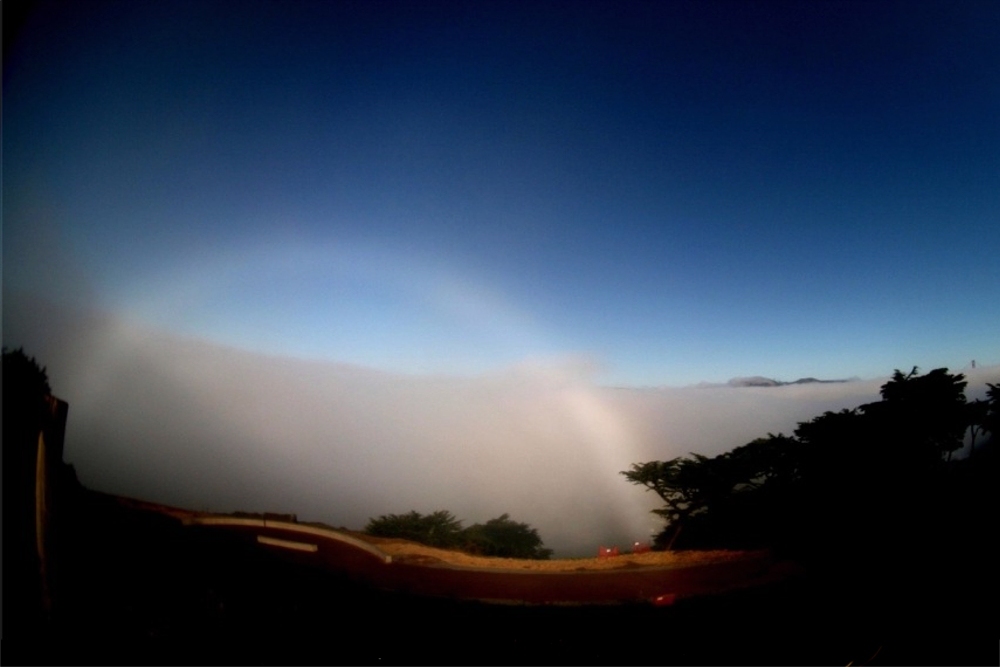
A Fogbow!

" Is that white arch real? What is being seen is a fogbow, a reflection of sunlight by water drops similar to a rainbow but without the colors. The fog itself is not confined to an arch -- the fog is mostly transparent but relatively uniform. The fogbow shape is created by those drops with the best angle to divert sunlight to the observer. The fogbow's relative lack of colors are caused by the relatively smaller water drops. The drops active above are so small that the quantum mechanical wavelength of light becomes important and smears out colors that would be created by larger rainbow water drops acting like small prisms reflecting sunlight. The above striking image of a fogbow was taken last week with the Sun behind the photographer. Close inspection of the far right of the full image will show one of the two suspension towers of the Golden Gate Bridge in California, USA."

Ah the perils of cut and paste

Didnt even know fogbows existed!

:)