Showing posts with label Saturn. Show all posts

Wednesday, February 04, 2009

The skies the limit


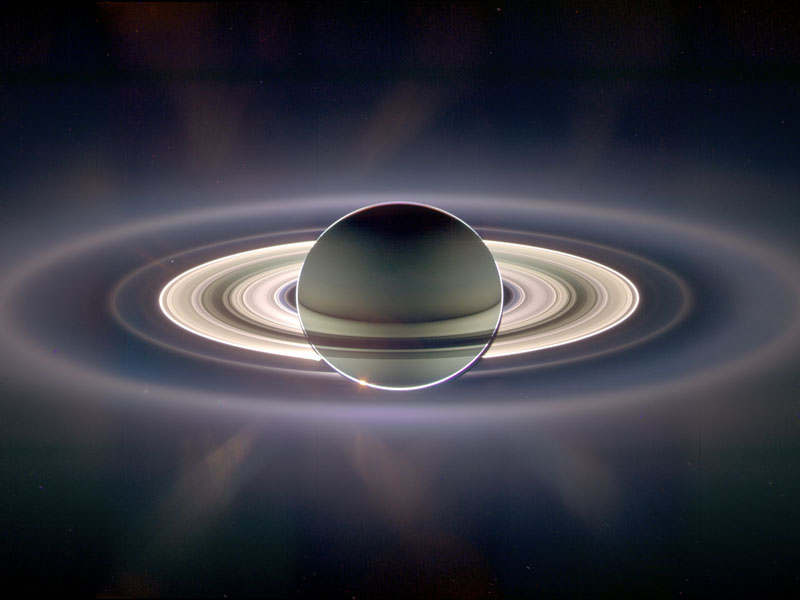
In the shadow of Saturn, unexpected wonders appear. The robotic Cassini spacecraft now orbiting Saturn recently drifted in giant planet's shadow for about 12 hours and looked back toward the eclipsed Sun. Cassini saw a view unlike any other. First, the night side of Saturn is seen to be partly lit by light reflected from its own majestic ring system. Next, the rings themselves appear dark when silhouetted against Saturn, but quite bright when viewed away from Saturn, slightly scattering sunlight, in this exaggerated color image. Saturn's rings light up so much that new rings were discovered, although they are hard to see in the image. Seen in spectacular detail, however, is Saturn's E ring, the ring created by the newly discovered ice-fountains of the moon Enceladus and the outermost ring visible above. Far in the distance, at the left, just above the bright main rings, is the almost ignorable pale blue dot of Earth.

What's happened to the setting Sun? An eclipse! Two days ago, the Moon eclipsed part of the Sun as visible from parts of Africa, Australia, and Asia. In particular the above image, taken from the Mall of Asia seawall, caught a partially eclipsed Sun setting over Manila Bay in the Philippines.

Why is there methane on Mars? No one is sure. An important confirmation that methane exists in the atmosphere of Mars occurred last week, bolstering previous controversial claims made as early as 2003. The confirmation was made spectroscopically using large ground-based telescopes by finding precise colors absorbed on Mars that match those absorbed by methane on Earth. Given that methane is destroyed in the open martian air in a matter of years, the present existence of the fragile gas indicates that it is currently being released, somehow, from the surface of Mars. One prospect is that microbes living underground are creating it, or created it in the past. If true, this opens the exciting possibility that life might be present under the surface of Mars even today. Given the present data, however, it is also possible that a purely geologic process, potentially involving volcanism or rust and not involving any life forms, is the methane creator. Pictured above is an image of Mars superposed with a map of the recent methane detection.

If every picture tells a story, this one might make a novel. The six month long exposure compresses the time from December 17, 2007 to June 21, 2008 into a single point of view. Dubbed a solargraph, the remarkable image was recorded with a simple pinhole camera made from a drink can lined with a piece of photographic paper. The Clifton Suspension Bridge over the Avon River Gorge in Bristol, UK emerges from the foreground, but rising and setting each day the Sun arcs overhead, tracing a glowing path through the sky. Cloud cover causes dark gaps in the daily Sun trails. In December, the Sun trails begin lower down and are short, corresponding to a time near the northern hemisphere's winter solstice date. They grow longer and climb higher in the sky as the June 21st summer solstice approaches.

Have you ever seen the band of our Milky Way Galaxy? In a clear sky from a dark location at the right time, a faint band of light becomes visible across the sky. Soon after your eyes become dark adapted, you might spot the band for the first time. It may then become obvious. Then spectacular. One reason for a growing astonishment might be the realization that this fuzzy swath contains billions of stars and is the disk of our very own spiral galaxy. Since we are inside this disk, the band appears to encircle the Earth. Visible in the above image, high above in the night sky, the band of the Milky Way Galaxy arcs. The bright spot just below the band is the planet Jupiter. In the foreground lies the moonlit caldera of the volcano Haleakala, located on the island of Maui in Hawaii, USA. A close look near the horizon will reveal light clouds and the dark but enormous Mauna Kea volcano on the Big Island of Hawaii. If you have never seen the Milky Way band or recognized the planet Jupiter, this year may be your chance.

Tomorrow, a few lucky people may see a "ring of fire." That's a name for the central view of an annular eclipse of the Sun by the Moon. At the peak of this eclipse, the middle of the Sun will appear to be missing and the dark Moon will appear to be surrounded by the bright Sun. This will only be visible, however, from a path that crosses the southern Indian Ocean. From more populated locations, southern Africa and parts of Australia, most of the Moon will only appear to take a bite out the Sun. Remember to never look directly at the Sun even during an eclipse. An annular eclipse occurs instead of a total eclipse when the Moon is on the far part of its elliptical orbit around the Earth. The next annular eclipse of the Sun will take place in 2010 January, although a total solar eclipse will occur this July. Pictured above, a spectacular annular eclipse was photographed behind palm trees on 1992 January.

Monday, November 10, 2008

Astronomy update


What's happening at the center of active galaxy 3C 75? The two bright sources at the center of this composite x-ray (blue)/ radio (pink) image are co-orbiting supermassive black holes powering the giant radio source 3C 75. Surrounded by multimillion degree x-ray emitting gas, and blasting out jets of relativistic particles the supermassive black holes are separated by 25,000 light-years. At the cores of two merging galaxies in the Abell 400 galaxy cluster they are some 300 million light-years away. Astronomers conclude that these two supermassive black holes are bound together by gravity in a binary system in part because the jets' consistent swept back appearance is most likely due to their common motion as they speed through the hot cluster gas at 1200 kilometers per second. Such spectacular cosmic mergers are thought to be common in crowded galaxy cluster environments in the distant universe. In their final stages the mergers are expected to be intense sources of gravitational waves.

Located just 500 light-years away toward the constellation Scorpius, this star is only slightly less massive and a little cooler than the Sun. But it is much younger, a few million years old compared to the middle-aged Sun's 5 billion years. This sharp infrared image shows the young star has a likely companion positioned above and left - a hot planet with about 8 times the mass of Jupiter, orbiting a whopping 330 times the Earth-Sun distance from its parent star. The young planetary companion is still hot and relatively bright in infrared light due to the heat generated during its formation by gravitational contraction. In fact, such newborn planets are easier to detect before they age and cool, becoming much fainter. Though over 300 extrasolar planets have been found using other techniques, this picture likely represents the first direct image of a planet belonging to a star similar to the Sun.

Why would Saturn show such strange colors? The robotic Cassini spacecraft currently orbiting Saturn has beamed back images showing that the northern hemisphere our Solar System's most spectacularly ringed planet has changed noticeably since Cassini arrived in 2004, now sporting unusual and unexpected colors. No one is sure why. Although the cause for many of Saturn's colors is unknown, the recent change in colors is thought to be related to the changing seasons. Pictured above, the unusual colors are visible just north of the dark ring shadows. The razor-thin plane of ring particles is visible nearly edge-on across the bottom of the image. The cloudy moon Titan looms large just above the rings, while close observation will reveal three other moons. Cassini arrived at Saturn in 2004, sending back data and images that have not only led to a deeper understanding of the Jovian world's atmosphere, moons, and rings, but also raised new mysteries.

On September 30, a spectacular bolide or fireball meteor surprised a group of amateur astronomers enjoying dark night skies over the Oklahoma panhandle's Black Mesa State Park in the Midwestern US. Flashing past familiar constellations Taurus (top) and Orion, the extremely bright meteor was captured by a hillside camera overlooking the 2008 Okie-Tex Star Party. Astronomy enthusiast Howard Edin reports that he was looking in the opposite direction at the time, but saw the whole observing field light up and at first thought someone had turned on their car headlights. So far the sighting of a such a bright bolide meteor, produced as a space rock is vaporized hurtling through Earth's atmosphere, really is a matter of luck.

Nineteenth century science fiction author Jules Verne wrote visionary works about Extraordinary Voyages including tales of space flight and the story of a journey From the Earth to the Moon. Fittingly, the European Space Agency's newly developed Automated Transfer Vehicle (ATV), a robotic spacecraft intended to deliver cargo to the International Space Station (ISS) was named in his honor and successfully docked with the ISS earlier this year. When the Jules Verne ATV was undocked and deorbited last month, its safely controlled reentry over the Pacific Ocean was followed by astronomers in order to make detailed comparisons of the actual event with computer models of spacecraft reentry and breakup in the atmosphere. This dramatic image of the fragmenting, 13-ton spacecraft is a high definition video frame recorded from NASA's DC-8 Airborne Laboratory.

Imagine a pipe as wide as a state and as long as half the Earth. Now imagine that this pipe is filled with hot gas moving 50,000 kilometers per hour. Further imagine that this pipe is not made of metal but a transparent magnetic field. You are envisioning just one of thousands of young spicules on the active Sun. Pictured above is perhaps the highest resolution image yet of these enigmatic solar flux tubes. Spicules dot the above frame of solar active region 10380 that crossed the Sun in 2004 June, but are particularly evident as a carpet of dark tubes on the right. Time-sequenced images have recently shown that spicules last about five minutes, starting out as tall tubes of rapidly rising gas but eventually fading as the gas peaks and falls back down to the Sun. These images also indicate that the ultimate cause of spicules is sound-like waves that flow over the Sun's surface but leak into the Sun's atmosphere.

Wednesday, October 15, 2008

Enceladus from Cassini


What a cracking photo! After Europa, Enceladus is my next bet for life in this solar system. Water, water, everywhere.........

"What telling impurities taint the ice plumes of Enceladus? To help answer this question, the robotic Cassini spacecraft dove last week to within 30 kilometers of Saturn's ice-plume emitting moon. At this closest-ever approach, Cassini attempted to sniff and obtain chemical data on particles ejected from Enceladus' regular surface, while at other times Cassini flew right through -- and sampled -- ice geysers directly. Searches in the data for impurity clues in the water-ice dominated plumes and surface ejecta are progressing. Although the main purpose of this flyby was particle analysis, several interesting images are emerging. Visible in the above image, for example, is an unusual gray sheen running vertically up the image center that might be water vapor escaping from surface canyons. Other notable features visible above include vast plains of craterless icy grooves, the day-night terminator across the image left, and an area near the top comparatively rich in craters."

Monday, August 04, 2008

Astronomy Picture of the Day


You might occasionally wonder where I get all the cool photos from space and beyond. NASA have a daily website called (funnily enough) Astronomy Picture of the Day. http://apod.nasa.gov/apod/astropix.html. They have been busy in the last few days. Enjoy! :)


1. The Echus chasm on Mars
2. Jupiter over Hadrians temple in Ephesus
3. Rhea and Saturn
4. The moon over the temple of Posiedon in Greece
5. Soyuz docking with the International Space Station

Tuesday, June 24, 2008

Monthly moon round-up - Dione


Size: 1,120 kilometers - 4th largest moon of Saturn
Orbital radius: 377,400 kilometers - 6.26 Saturn radii - within the E ring
Orbital period: 2.737 days - about 1/6 of Titan's
Discovery: 1684 by Giovanni Domenico Cassini

Dione's globe is dominated by a star-like pattern of bright "wispy terrain" -- or so it appeared from the Voyagers' distant views. It was long speculated that the wispy terrain represented relatively fresh volcanic flows of icy material. Close views from Cassini have revealed that the wisps are not volcanic features at all. They are exposed cliff faces, a terrain created by the fracturing and faulting of Dione's surface. In fact, there are fractures to be seen everywhere on Dione, representing multiple generations of tectonic events. Some slice up craters, while others have craters superimposed on them.

Features on Dione are named for people and places from Virgil's Aeneid, which complements similar Tethys' naming scheme (the Odyssey).

Like Tethys, Dione has little rocks keeping it company in its Lagrange points: Helene occupies the same orbit as Dione, 60 degrees ahead, while Polydeuces occupies the same orbit, 60 degrees behind.

Sunday, March 16, 2008

Monthly moon round-up - Titan


Titan is doing its best to become my favourite moon, although my heart will always belong to Europa ;)

Since the marvelous Huygens probe was dropped onto the surface last year, the main Cassini space craft is orbiting the Saturn system and has been taking un precidented pictures of the surface using radiowaves. Titans atmosphere normally makes surface pictures impossible, but the new equipment on Cassini gives a window on the surface we've never had before.

And there they are!! Lakes and rivers of Methane!! With drainage channels and other features associated with a free-flowing liquid. Cool as!

Ah Titan :)

Sunday, December 23, 2007

Space, above and beyond


There's been some fantastic astronomy pictures published in my absence. Here's just a few of them. (Please) click to enlarge.

1. My favourite moon Europa

2. The International Space Station

3. Alborz Mountains in Moonlight

4. Comet McNaught at dawn

5. Saturns rings and its moon Tethys.

Sunday, October 21, 2007

Iapetus


Its your monthly moon round-up.

This is Saturns moon, Iapetus. And it is half covered in black stuff. We're not too sure what this stuff is, but we are guessing its Carbon. Quite how it got there, we dont know - it could be volcanic but we dont inderstand the process.

The close up is from a fly-by by the probe Cassini. Incredible details! :)

Wanna go, now!

Monday, October 15, 2007

Its a beautiful universe


I've been away for a few days to Blackpool (dont ask! lol), and it seems a vertiable dearth of beautiful images.

So heres something to feast your eyes on at the start of the working week. Click on them to enlarge. :)

Its all rather pretty out there :D

1. The complexity of Jupiters clouds

2. Ice geysers on Saturns moon Enceladus. The geysers are estimated to be 0 degrees Celcius, but as the planet itself is -200C then it will geyser like crazy.

3. The Whale and the Hockystick galaxies.

4. And the most beautiful photo of an aurora I've ever seen.

Friday, May 11, 2007

Moons and Rings


You know I like moons. These fantastic photos show just some of the many, many moons of Saturn and Jupiter.


1. I love this photo! This shows Saturns moon Enceladus creating one of Saturns rings. Like a comet, when the Sun hits the moon, the ice evaporates and creates a tail. Due to Saturns immense gravity the ice vapour follows Enceladus in orbit around the planet. We have never seen this view before because the Sun was behind us. It was only when the Cassini probe flew to the other side of Saturn and looked back, and Enceladus was silloutted could we see this ring creation in action.

2. Saturns moon Epimetheus against the rings.

3. My favourite moon Europa (still the best hope for extra terrestrial life, IMHO) rising over Jupiter.


Niiiice!

Wednesday, April 25, 2007

Hexagonal clouds on Saturn


" Why would clouds form a hexagon on Saturn? Nobody is yet sure. Originally discovered during the Voyager flybys of Saturn in the 1980s, nobody has ever seen anything like it anywhere else in the Solar System. If Saturn's South Pole wasn't strange enough with its rotating vortex, Saturn's North Pole might now be considered even stranger. The bizarre cloud pattern is shown above in a recent infrared image taken by the Saturn-orbiting Cassini spacecraft. The images show the stability of the hexagon even 20 years after Voyager. Movies of Saturn's North Pole show the cloud structure maintaining its hexagonal structure while rotating. Unlike individual clouds appearing like a hexagon on Earth, the Saturn cloud pattern appears to have six well defined sides of nearly equal length. Four Earths could fit inside the hexagon. Although full explanations are not yet available, planetary scientists are sure to continue to study this most unusual cloud formation for quite some time."

Sunday, November 26, 2006

Janus and Epimetheus

This is Saurns moon Janus.

Janus [JAY-nus] is the sixth satellite of Saturn. It was discovered by Audouin Dollfus in 1966 and was named after the god of gates and doorways. It is depicted with two faces looking in opposite directions. Janus has an irregular shape with a size of 196x192x150 kilometers (122x119x93 miles) in diameter. It is heavily cratered with several craters 30 kilometers (19 miles) in diameter. The pervasive cratering indicates that its surface must be several billion years old

And this is Epimetheus.

Epimetheus [ep-eh-MEE-thee-us] is the fifth satellite of Saturn. It was discovered by R. Walker in 1980. Epimetheus was the son of Iapetus and brother to Prometheus and Atlas. Epimetheus means hindsight in Greek. It has an irregular shape with a size of 144x108x98 kilometers (89x67x61 miles) in diameter. It is traversed by several large and small grooves, valleys and ridges. Several craters larger than 30 km can be seen on its surface. The pervasive cratering indicates that its surface must be several billion years old.

Epimetheus and Janus share the same orbit of 151,472 kilometers from Saturn's center or 91,000 kilometers above the cloud tops. They are only separated by about 50 kilometers. As these two satellites approach each other they exchange a little momentum and trade orbits; the inner satellite becomes the outer and the outer moves to the inner position. This exchange happens about once every four years. Janus and Epimetheus may have formed from a disruption of a single parent to form co-orbital satellites. If this is the case, the disruption must have happened early in the history of the satellite system.

Saturday, September 16, 2006

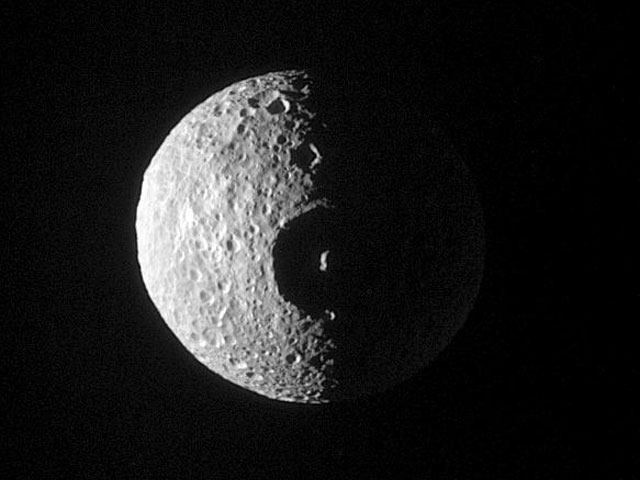
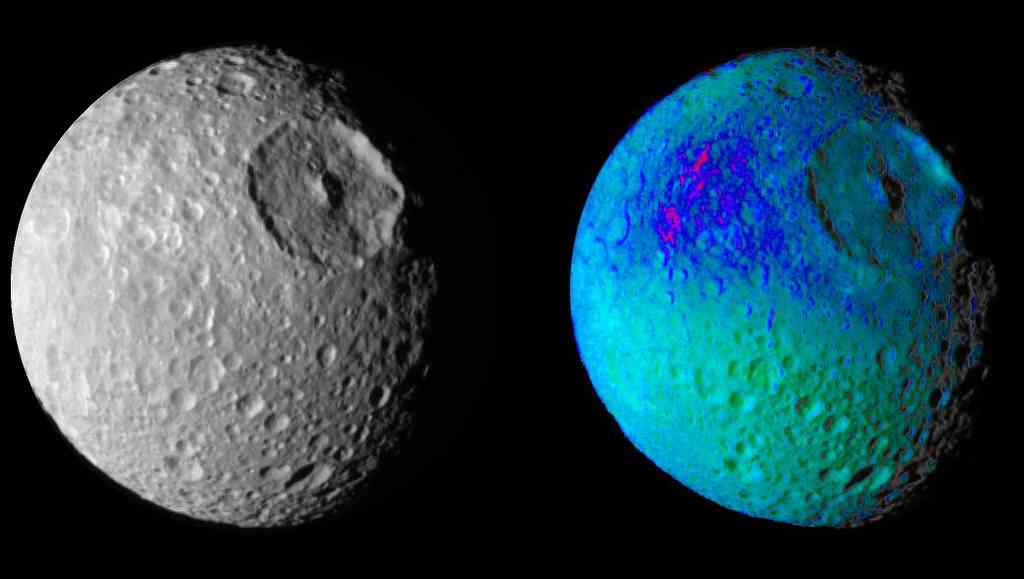
Herschel left an impresion on Mimas.


Spare a thought for Mimas, Suturns moon.

The outer Giants are responsible for life on Earth. Life would never have started, or certainly got as complex, if the outer giants werent hoovering up meteors that otherwise would have slammed into Earth.

We've already seen Shoemaker-Levy 9 hit Jupiter. This is what happened to Mimas.

Scientists think that if this impact had been any bigger Mimas wouldnt have survived. It would have been blown to bits.

Instead we have one of the best impact craters in the Solar System.
It is 130km across and they call it Herschel.

Big, huh. lol