Showing posts with label comets/meteors. Show all posts

Monday, April 12, 2010

Astronomy pics

I've been slacking on the pics recently. Here's a batch I've been saving for a while.


Thursday, August 20, 2009

We are all made of stars

Discovery by Stardust probe in Wild 2 comet suggests life on Earth began in space.

(C) www.timesonline.co.uk

A fundamental building block of biology has been discovered in wisps of stardust from the tail of a comet, offering fresh evidence that life on Earth could have begun from matter that arrived on our planet from space.

New analysis of tiny particles captured by the Stardust comet-chasing probe has revealed for the first time the presence of traces of an amino acid called glycine, a basic component of proteins without which life as we know it could not exist.

The discovery, by Nasa scientists, supports a theory that the raw material from which life began first formed in space, and was carried to Earth by comets that crashed into the planet. It also means that other planets are likely to have been seeded with amino acids from comets in a similar fashion, suggesting that extraterrestrial life may well have evolved elsewhere in the Universe and could even be common.

“Glycine is an amino acid used by living organisms to make proteins, and this is the first time an amino acid has been found in a comet,” said Jamie Elsila, of Nasa’s Goddard Space Flight Centre in Maryland, who led the research. “Our discovery supports the theory that some of life’s ingredients formed in space and were delivered to Earth long ago by meteorite and comet impacts.”

Carl Pilcher, director of the Nasa Astrobiology Institute, said: “The discovery of glycine in a comet supports the idea that the fundamental building blocks of life are prevalent in space, and strengthens the argument that life in the Universe may be common rather than rare.”

The discovery is the latest to come from Nasa’s unmanned Stardust mission, which flew through the cloud of dust and debris trailing the Wild 2 comet on January 2, 2004.

Millions of tiny particles from the comet’s tail were captured by a grid filled with aerogel, a super-light, sponge-like material sometimes nicknamed “frozen smoke” because 99 per cent of its volume is empty space.

A capsule containing the collection grid detached from the spacecraft soon after its close encounter with Wild 2 and returned to Earth, where it parachuted to the surface on January 15, 2006. Scientists have since been examining the contents of the capsule for clues about the early solar system.

All forms of life on Earth rely on proteins, which drive chemical reactions in their cells and form many of the structural elements around which organisms are built. This huge variety of proteins are all made up of chains of 20 amino acids.

The origin of amino acids has long been debated among scientists, with some favouring the view that they emerged in the primordial soup of the planet’s youth, and others proposing that they formed in space and came here on comets and meteorites.

The discovery of glycine in the Stardust samples points towards an extraterrestrial origin for at least one of the 20 amino acids.

Dr Elsila’s team first identified traces of glycine last year, in particles removed both from the aerogel and aluminium foil around it. As glycine is also present on Earth, however, the scientists had to confirm that it originated from space. The team used isotopic analysis to examine the chemical composition of the glycine. Many elements occur in different isotopes, or versions, which have different masses.

“We discovered that the Stardust-returned glycine has an extraterrestrial carbon isotope signature, indicating that it originated on the comet,” Dr Elsisa said.

The Stardust probe will fly past the comet Tempel 1 in 2011.

Monday, November 10, 2008

Astronomy update


What's happening at the center of active galaxy 3C 75? The two bright sources at the center of this composite x-ray (blue)/ radio (pink) image are co-orbiting supermassive black holes powering the giant radio source 3C 75. Surrounded by multimillion degree x-ray emitting gas, and blasting out jets of relativistic particles the supermassive black holes are separated by 25,000 light-years. At the cores of two merging galaxies in the Abell 400 galaxy cluster they are some 300 million light-years away. Astronomers conclude that these two supermassive black holes are bound together by gravity in a binary system in part because the jets' consistent swept back appearance is most likely due to their common motion as they speed through the hot cluster gas at 1200 kilometers per second. Such spectacular cosmic mergers are thought to be common in crowded galaxy cluster environments in the distant universe. In their final stages the mergers are expected to be intense sources of gravitational waves.

Located just 500 light-years away toward the constellation Scorpius, this star is only slightly less massive and a little cooler than the Sun. But it is much younger, a few million years old compared to the middle-aged Sun's 5 billion years. This sharp infrared image shows the young star has a likely companion positioned above and left - a hot planet with about 8 times the mass of Jupiter, orbiting a whopping 330 times the Earth-Sun distance from its parent star. The young planetary companion is still hot and relatively bright in infrared light due to the heat generated during its formation by gravitational contraction. In fact, such newborn planets are easier to detect before they age and cool, becoming much fainter. Though over 300 extrasolar planets have been found using other techniques, this picture likely represents the first direct image of a planet belonging to a star similar to the Sun.

Why would Saturn show such strange colors? The robotic Cassini spacecraft currently orbiting Saturn has beamed back images showing that the northern hemisphere our Solar System's most spectacularly ringed planet has changed noticeably since Cassini arrived in 2004, now sporting unusual and unexpected colors. No one is sure why. Although the cause for many of Saturn's colors is unknown, the recent change in colors is thought to be related to the changing seasons. Pictured above, the unusual colors are visible just north of the dark ring shadows. The razor-thin plane of ring particles is visible nearly edge-on across the bottom of the image. The cloudy moon Titan looms large just above the rings, while close observation will reveal three other moons. Cassini arrived at Saturn in 2004, sending back data and images that have not only led to a deeper understanding of the Jovian world's atmosphere, moons, and rings, but also raised new mysteries.

On September 30, a spectacular bolide or fireball meteor surprised a group of amateur astronomers enjoying dark night skies over the Oklahoma panhandle's Black Mesa State Park in the Midwestern US. Flashing past familiar constellations Taurus (top) and Orion, the extremely bright meteor was captured by a hillside camera overlooking the 2008 Okie-Tex Star Party. Astronomy enthusiast Howard Edin reports that he was looking in the opposite direction at the time, but saw the whole observing field light up and at first thought someone had turned on their car headlights. So far the sighting of a such a bright bolide meteor, produced as a space rock is vaporized hurtling through Earth's atmosphere, really is a matter of luck.

Nineteenth century science fiction author Jules Verne wrote visionary works about Extraordinary Voyages including tales of space flight and the story of a journey From the Earth to the Moon. Fittingly, the European Space Agency's newly developed Automated Transfer Vehicle (ATV), a robotic spacecraft intended to deliver cargo to the International Space Station (ISS) was named in his honor and successfully docked with the ISS earlier this year. When the Jules Verne ATV was undocked and deorbited last month, its safely controlled reentry over the Pacific Ocean was followed by astronomers in order to make detailed comparisons of the actual event with computer models of spacecraft reentry and breakup in the atmosphere. This dramatic image of the fragmenting, 13-ton spacecraft is a high definition video frame recorded from NASA's DC-8 Airborne Laboratory.

Imagine a pipe as wide as a state and as long as half the Earth. Now imagine that this pipe is filled with hot gas moving 50,000 kilometers per hour. Further imagine that this pipe is not made of metal but a transparent magnetic field. You are envisioning just one of thousands of young spicules on the active Sun. Pictured above is perhaps the highest resolution image yet of these enigmatic solar flux tubes. Spicules dot the above frame of solar active region 10380 that crossed the Sun in 2004 June, but are particularly evident as a carpet of dark tubes on the right. Time-sequenced images have recently shown that spicules last about five minutes, starting out as tall tubes of rapidly rising gas but eventually fading as the gas peaks and falls back down to the Sun. These images also indicate that the ultimate cause of spicules is sound-like waves that flow over the Sun's surface but leak into the Sun's atmosphere.

Tuesday, September 16, 2008

Large Impact Simulation

I watched last night one of the best clips I have ever seen on Youtube. I don't know if it was because I was a wee bit tipsy lol, or because the clip uses the music of the brillaint Great Gig In The Sky, written by Richard Wright of Pink Floyd who sadly died yesterday, but I was left stunned by watching it.

Either way this clip, created by the Discovery Channel, is a stunning piece of animation, set to incredibly evokative music, and is both beautiful and terrifying at the same time.

I hope you enjoy this half as much as I did.

Thursday, August 14, 2008

Perseids


We are currently passing through the Perseid meteor shower. Something the Earth does every year. Here are a couple of cool shots from the year and previous years shows. Niiiice!

Sunday, December 23, 2007

Space, above and beyond


There's been some fantastic astronomy pictures published in my absence. Here's just a few of them. (Please) click to enlarge.

1. My favourite moon Europa

2. The International Space Station

3. Alborz Mountains in Moonlight

4. Comet McNaught at dawn

5. Saturns rings and its moon Tethys.

Friday, November 23, 2007

Something for the weekend


There were a bunch of quality photos available today, so I thought I would put some up for you.

I keep intending not to publish anymore photos of Auroras, yet I keep coming across fantastic photos of them; and each one better than the last! lol

There is another fantastic close-up of Comet Holmes. And a wonderful shot of Earthrise! Taken my a Japanese probe that is orbitting the Moon right now. Beautiful :)

Have a nice weekend!

Friday, October 05, 2007

I told you it was dangerous out there!


I have often gone on about how powerful the various cosmic rays out in space are. Bursts of energy that are measured in terms greater than we can comprehend. Our Sun churns out more energy in day than all the nuclear energy ever generated on this planet.

The Sun preiodically chucks out lumps of its self into space in whats called a Coronal Mass Ejection (CME). They dont cause us too much trouble as we have a magnetic field and an atmosphere to keep most of the energy out. The energy hit its the force field of our magnetic field, and ripples across it in what we call the Aurora ;)


Please click on this link and play clip on the page: http://antwrp.gsfc.nasa.gov/apod/ap071003.html

What you are watching is a comet run into a Cornal Mass Ejection and having its ten million mile tail ripped off!

I told you it was powerful out there.

Sunday, January 28, 2007

Above the clouds

Another day, another cool photo. Comet Mcnaught see in the sky above an observatory in Hawaii.
Nice!!!

Tuesday, August 29, 2006

Earths first Spaceport?


Sooner or later, we gotta get of this planet. Me thinks sooner, judging reports about global warming and the on-coming War of the Cultures.

Over-population and the usage of our natural resources means that we must find some resources (and even somewhere else to live) before Earth has another Extinction Level Event (ELE). We know a giant rock is coming to change the order of things. It has happened 5 times we know of already. The dinosuar event, 65 million years ago in the Chixalub in Mexico is just the fifth ELE that they know of.


And of course I havent mentioned Super Volcanoes, Global Plagues, Ice Ages, and good old fashioned Thermal Nuclear Death.

sings "We gotta get out of this place". But how?

It is actually really fuel intensive to get of this planet. So much of a rockets fuel is just needed to break the Earths atmospere. You probably couldnt launch a vessel that was meant to go deep space and back again with conventional rocket fuel. It would probably weigh too much. Thats why they dont paint the fuel cells on the shuttle. The extra weight would mean extra fuel to cover it, and even more fuel to cover the extra weight of the extra fuel! phew!

So if you could launch from somewhere where you didnt have to break the Earths atmosphere, you could take so much extra fuel with you for your deepspace exploring or mining trip! Nice :)

And finally, what is the main componant of rocket fuel? Hydrogen, the H in H2O.

Which brings us to that magnificent photo from the Mars Exress showing a crater at the north pole of Mars full of water ice. It is about 10km across and about 200/400 meters thick. And its not the only crater at the pole. Concieivably, you could build a base at the poles of Mars, build a machine that converts water into Hydrogen fuel, and launch missions from there.

Many years in the future, I fear; but we have the technology now, not the political will.

Peace out.

Sunday, August 13, 2006

Shoemaker-Levy 9


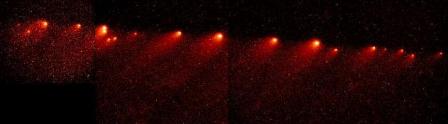
On the 18th July 1994, comet Shoemaker-Levy 9 slams into Jupiter.

"The power and size of the explosions of most fragments far exceeded most predictions. Although the visible flashes were out of sight, in infra-red the huge mushroom clouds, some bigger than the entire Earth, could be seen rising up over the edge of Jupiter. The power of the biggest explosion, that of fragment G, was estimated at 250 million megatons of TNT, 17 billion times bigger than the bomb dropped on Hiroshima in 1945 (yield 15 kilotons). Even the biggest hydrogen bomb ever exploded by mankind, 50 megatons, is tiny by comparison."

Cool, huh?

Arnt we small, lol?